
This material was created for professionals, managers, entrepreneurs, and technology teams who want to understand artificial intelligence in a didactic way, while also recognizing the data, security, and infrastructure requirements needed to use AI in an enterprise environment.
The history of artificial intelligence: from a philosophical question to a global infrastructure
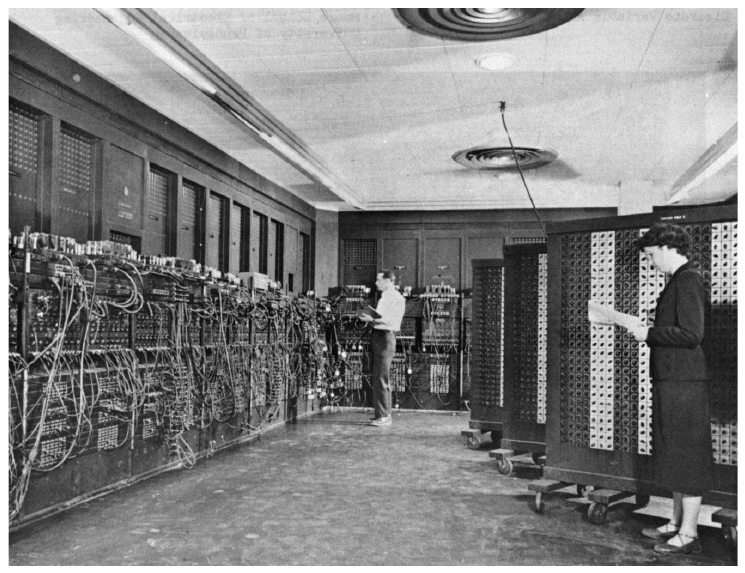
Before the term "artificial intelligence" existed, scientists were already trying to transform reasoning into formal procedures. Electronic computing was born in a context in which military calculations, mathematical logic, and information theory began to converge. Machines like the ENIAC showed that operations previously dependent on human labor could be automated at unprecedented speed, but programming was still a physical and laborious process.

In 1950, Alan Turing published "Computing Machinery and Intelligence" and shifted the discussion from "can machines really think?" to an operational question: could a machine behave, in a conversation, in a way convincing enough to be mistaken for a human being? The so-called imitation game became one of the intellectual milestones of the field.
In 1955, John McCarthy, Marvin Minsky, Nathaniel Rochester, and Claude Shannon proposed a summer project at Dartmouth. The 1956 meeting is widely regarded as the birth of artificial intelligence as a discipline. The central point of the proposal was ambitious: aspects of learning and intelligence could be described with sufficient precision for a machine to simulate them.
From then on, AI went through cycles of enthusiasm and frustration. In the 1960s and 1970s, symbolic systems and experiments such as ELIZA emerged. When promises exceeded the capacity of hardware, data, and algorithms, the so-called "AI winters" arrived, periods of reduced investment. In the 1980s, expert systems regained interest by encoding human expert rules for specific domains.
In 1997, IBM's Deep Blue supercomputer defeated Garry Kasparov in a six-game match. The feat demonstrated the power of massively parallel search and specialized hardware. It was not yet today's generative AI, but it changed public perception of what computers could do.
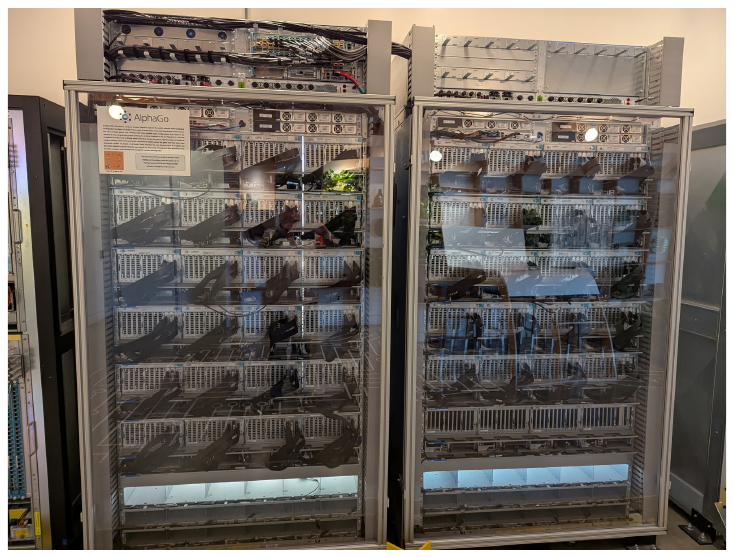
The next turning point came with data at scale, GPUs, and deep neural networks. In 2012, AlexNet achieved far superior results on ImageNet and helped establish deep learning as the dominant approach in computer vision. In 2016, AlphaGo defeated Lee Sedol 4-1 by combining neural networks, search, and reinforcement learning, demonstrating that systems could learn highly complex strategies.
In 2017, the paper "Attention Is All You Need" introduced the Transformer architecture. Instead of processing sequences only step by step, attention mechanisms began relating different parts of the context with great parallelization efficiency. This architectural foundation paved the way for today's large language models.
On November 30, 2022, ChatGPT was introduced in a conversational format and accelerated public adoption of generative AI. Between 2023 and 2026, the frontier advanced toward multimodal models, reasoning, video generation, programming, and agents capable of using tools. The enterprise discussion has changed: it is no longer just "what can AI answer?" but "which processes can it execute, with which data, controls, and infrastructure?"
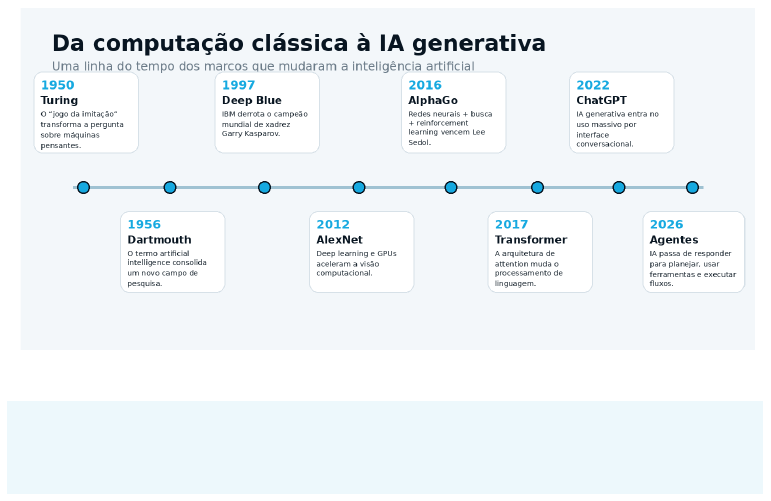
Key idea: the history of AI is not a straight line. Progress results from the combination of three factors: better algorithms, more data, and more computing capacity. When one of them falls behind, progress slows down.
From ENIAC to AI data centers
The contrast between the first electronic computers and modern clusters is instructive. The ENIAC filled entire rooms and was reprogrammed with cables and panels. Today, an AI infrastructure concentrates thousands of accelerators, ultra-high-speed networks, and distributed storage. Physical scale has again become central, now to support models with billions or trillions of parameters and continuous inference workloads.
What is artificial intelligence, in simple language
Artificial intelligence is a field of computing dedicated to systems capable of performing tasks that we normally associate with perception, learning, reasoning, prediction, language, content generation, or decision-making. The definition is broad because AI is not a single product: it is a family of techniques and architectures.
A spam filter, a recommendation system, a fraud detector, a model that identifies objects in video, and an assistant that writes a report can all be considered AI applications, even though they use different technologies.
The most useful distinction for beginners is to separate AI, machine learning, deep learning, and generative AI. Machine learning is a subset of AI in which models learn patterns from data. Deep learning is a subset of machine learning based on neural networks with multiple layers. Generative AI is a class of systems, often based on deep learning, trained to create new content.
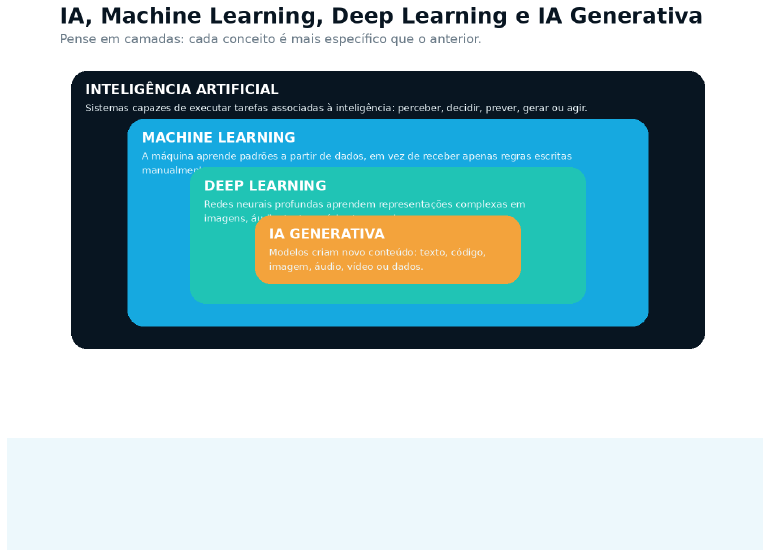
Do not confuse automation with AI: automation can follow fixed rules without learning anything. AI becomes relevant when the system needs to recognize patterns, handle uncertainty, interpret language, or generate responses. Many enterprise solutions combine both.
How machines learn: data, training, and inference
In traditional programming, the developer writes explicit rules and the software applies these rules to the data. In machine learning, we provide examples and an algorithm adjusts parameters to reduce errors. The result of this process is a model.
Training is the stage in which the model adjusts its parameters. Inference, on the other hand, is the moment when a trained model receives new data and produces a prediction, classification, recommendation, or generation. This difference has a direct impact on infrastructure: training usually demands large GPU blocks and long computation periods; inference can range from a CPU to clusters of accelerators, depending on model size and desired latency.
Three paradigms appear frequently. In supervised learning, each example has a label and the model learns to associate input and output. In unsupervised learning, the system looks for structure in data without explicit labels. In reinforcement learning, an agent learns through trial and error to maximize rewards.
In enterprise practice, the ML cycle includes data collection, processing, training/test split, training, validation, deployment, and monitoring. Models degrade when the behavior of the world changes, a phenomenon known as drift. That is why AI in production is an ongoing operational discipline, not a project that ends at the first deployment.
Didactic example — churn prediction: a carrier can train a model with usage history, calls, payments, and cancellations. The goal is not to "guess" randomly, but to learn patterns associated with customers who canceled. During inference, the model calculates the probability of churn for active customers. Value is created when this prediction is integrated into an action: an offer, support, or a commercial intervention.
Neural networks and deep learning: why they leapt forward
Artificial neural networks are models composed of mathematical units organized into layers. Each connection carries weights that are adjusted during training. The deeper and better suited the architectures are to the problem, the greater the capacity to learn complex representations.
The advance of deep learning did not happen because of a single invention. GPUs enabled many operations to run in parallel; large datasets provided examples; new training techniques improved stability and generalization; and software libraries democratized development.
Convolutional Neural Networks gained prominence in images. Recurrent networks and their variants were important for sequences. Transformers became dominant in language and expanded into vision, audio, and multimodality. The common principle is to learn representations directly from data, reducing the need to manually specify all relevant features.
Why GPU? Training neural networks requires an enormous volume of matrix multiplications. GPUs were designed for highly parallel computation and therefore became the foundation of many AI workloads. The choice between GPU, CPU, or other accelerators depends on the model, budget, latency, and scale.
Generative AI and LLMs: how the new generation works
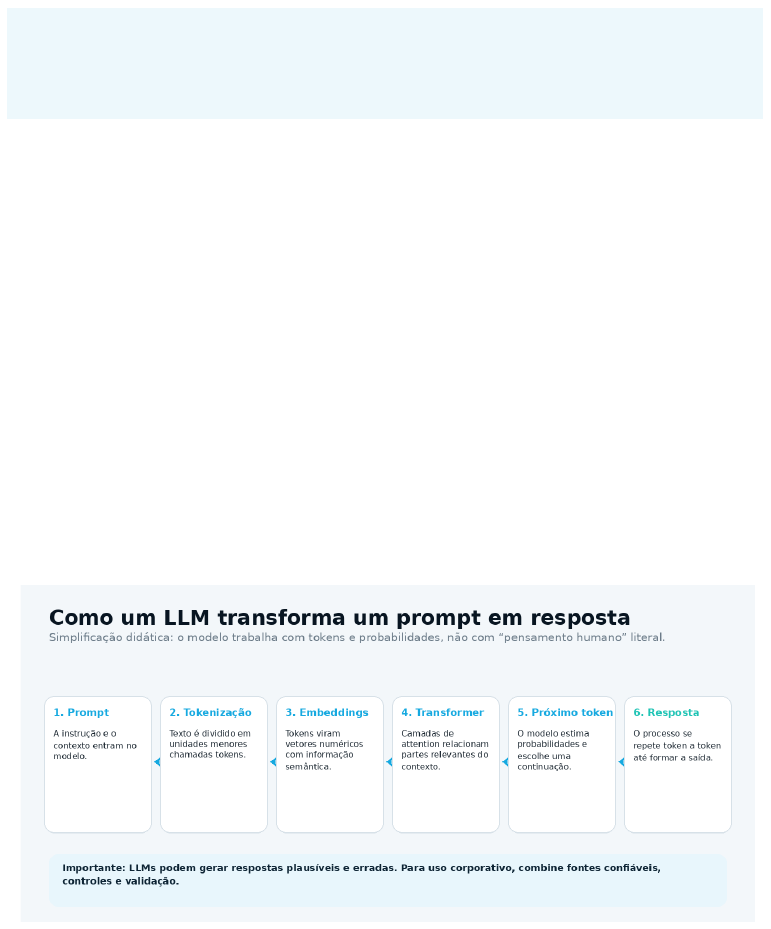
Generative AI creates new content based on learned patterns. In language models, the fundamental mechanism is to predict sequences of tokens conditioned on prior context. This description seems simple, but large-scale models learn language regularities, factual knowledge, code structures, and semantic relationships capable of supporting very different tasks.
Tokens are units into which text is divided. Embeddings represent tokens or passages as numerical vectors. The Transformer applies attention mechanisms to calculate which parts of the context are most relevant at each step. The model then estimates the probability distribution of the next token and repeats the process until the response is formed.
An LLM is not a traditional database. It compresses patterns into parameters and can produce plausible information that does not correspond to reality. This explains "hallucinations." The higher the criticality of the task, the more important it is to limit sources, require evidence, log decisions, and maintain human validation when necessary.
Context is another essential concept. Each model has a context window that determines how much content it can consider in an interaction. Larger contexts help with long documents, but do not eliminate the need for architecture. Dumping the entire corporate archive into the prompt is expensive, slow, and unsafe; RAG and search tools select only what matters.
A good prompt defines objective, context, constraints, format, and quality criteria. In professional applications, the prompt is only one layer. Quality also depends on the model, the data, the tools, the orchestration, and the tests.
Fine-tuning or RAG? RAG is appropriate when the main problem is bringing in up-to-date, traceable knowledge. Fine-tuning is more useful for changing behavior, style, format, or performance in a domain. Many architectures combine both.
RAG: AI connected to company data
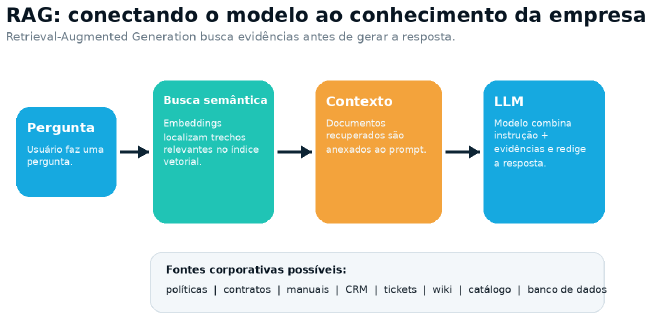
RAG, short for Retrieval-Augmented Generation, adds an information retrieval step before generation. When the user asks a question, the application searches for relevant excerpts in authorized sources and sends this evidence to the model. The response can then be drafted based on up-to-date corporate content.
A typical implementation starts with document ingestion, cleaning, chunking, embedding generation, and indexing in a vector or hybrid search engine. At query time, the question is also converted into an embedding, the system retrieves candidates, applies filters and possibly a reranker, and only then assembles the final context for the LLM.
RAG improves traceability and freshness, but it is not an automatic guarantee of truth. Retrieval can fetch the wrong document, miss an important passage, or expose content without authorization. Mature systems apply access control at the source level, metadata, filters, citations, evaluation, and logs.
Enterprise example: an internal assistant can answer "what is the backup policy for this type of environment?" by fetching the current version of the document, citing the excerpt used, and respecting the user's permissions. This is very different from relying solely on the model's general memory.
AI agents: from response to execution
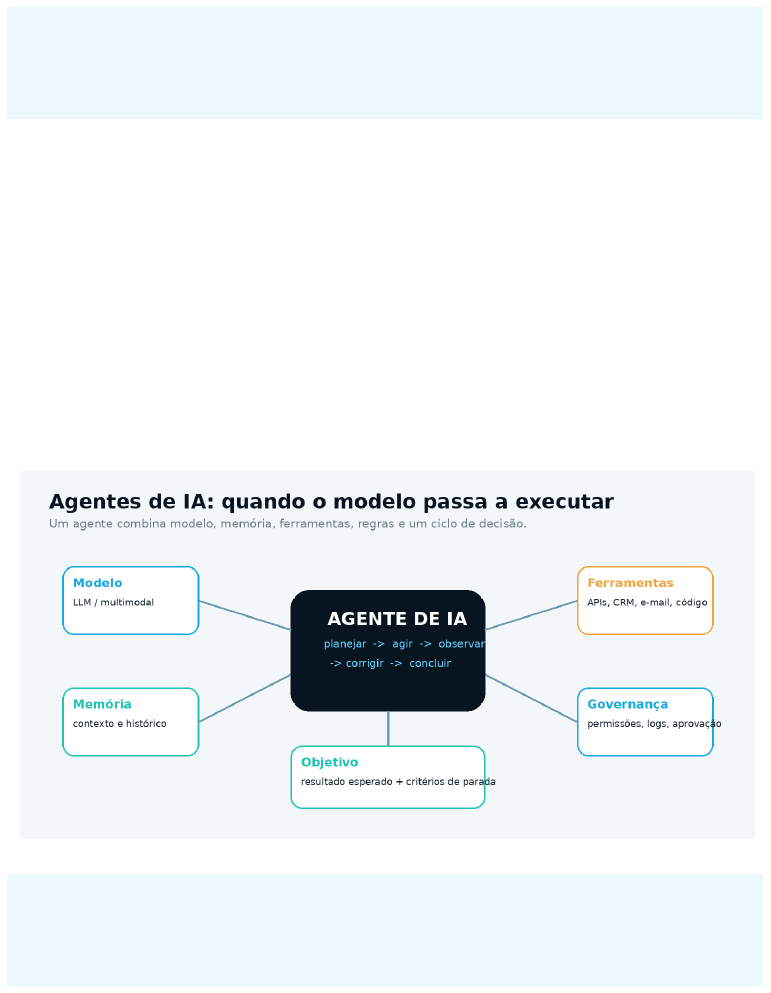
AI agents expand the role of a model. Instead of just producing text, an agent receives an objective, plans steps, calls tools, observes results, and decides what to do next. Tools can include APIs, databases, CRM, ITSM, browsers, code repositories, spreadsheets, or internal systems.
This capability makes agents attractive for multi-step processes: qualifying leads, consolidating account data, preparing proposals, classifying tickets, investigating incidents, generating code, validating documentation, or executing controlled routines. But autonomy requires proportional governance.
The greater the power to act, the greater the risk of error. An agent with read-only permission presents a different risk profile than an agent capable of deleting data, approving payments, or changing infrastructure. Proper design includes least privilege, action limits, parameter validation, human approvals, logs, and rollback mechanisms.
Golden rule: autonomy should be earned through evidence. Start with "assist," evolve to "recommend," then "execute with approval," and only then evaluate autonomous execution for low-risk, highly observable tasks.
Where AI generates value in companies
The best AI project does not start with the question "which model should we use?" but with "which process do we want to improve and how will we measure it?" High-value use cases generally combine volume, repetition, available data, and economic impact.
In customer service, AI can classify contacts, summarize history, suggest responses, and retrieve policies. In sales, it can research accounts, enrich CRM, prepare follow-ups, and prioritize opportunities. In operations, it can summarize incidents, correlate alarms, and speed up troubleshooting. In development, it can generate, review, and test code. In documents, it can extract fields, compare clauses, and produce summaries.
In the data center and cloud environment, AI can support capacity planning, failure prediction, log analysis, anomaly detection, energy optimization, assisted NOC, and technical support. The gain is greater when AI is connected to reliable operational data and existing workflows.
| Area | Use case | Typical architecture | Value indicator |
|---|---|---|---|
| Customer service | Policy-based assisted response | LLM + RAG + CRM | average time, resolution, quality |
| Sales | Research and preparation of opportunities | Agent + CRM + authorized sources | time per account, conversion, pipeline |
| IT Operations | Incident summary and triage | LLM + logs + ITSM + rules | MTTR, backlog, accuracy |
| Documents | Extraction and comparison | Multimodal/OCR + LLM + validation | time, error, productivity |
| Engineering | Code and testing copilot | LLM + repository + controlled CI/CD | lead time, bugs, coverage |
| Data Center/NOC | Anomalies and operational correlation | Temporal ML + agent + observability | incidents, availability, energy |
Infrastructure for AI: GPU, storage, network, and data center
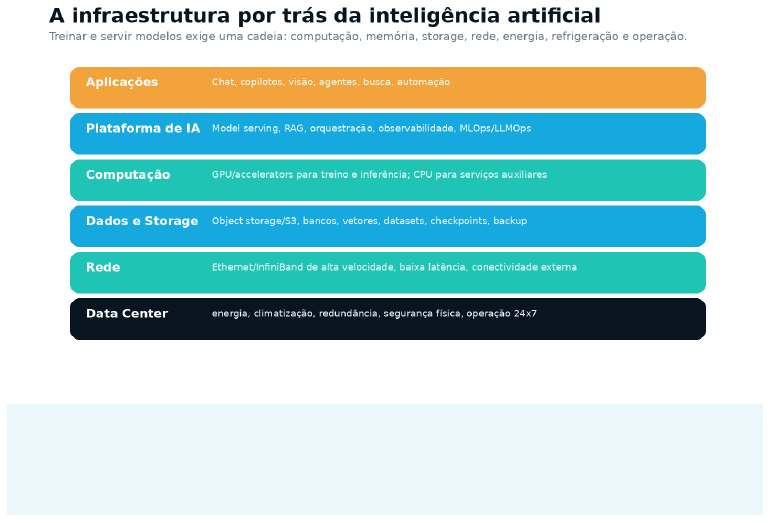
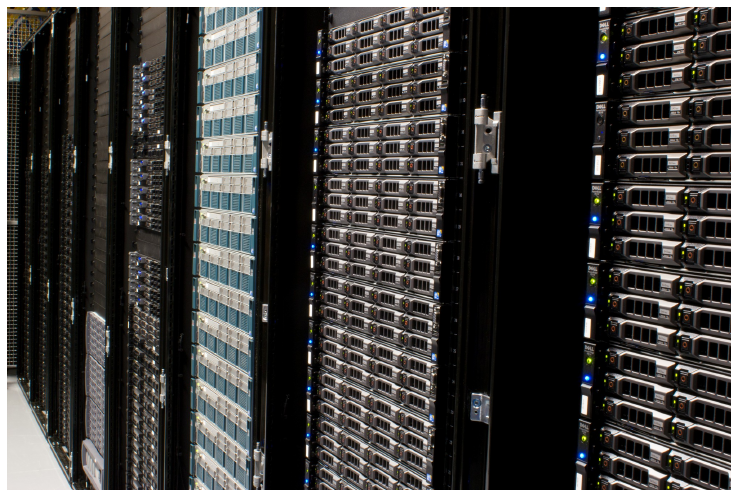
AI is software, but the user experience is limited by physical infrastructure. Large models require accelerated computing, high-bandwidth memory, storage capable of feeding datasets and checkpoints, low-latency networking, and consistent electrical and thermal operations.
Sizing begins with the type of workload. Training models from scratch is the most intensive scenario and is rarely necessary for an ordinary company. Fine-tuning may require one or a few nodes, depending on the model and technique. Inference can run on dedicated GPU, shared GPU, cloud accelerators, or even CPU for compact models.
Besides the accelerator, memory is critical. If the model does not fit in available memory, it may be necessary to quantize, distribute across GPUs, or choose a smaller model. Storage also affects the cycle: datasets, embeddings, artifacts, logs, and checkpoints grow quickly. S3-compatible object storage is especially useful for datasets and artifacts at scale.
The network becomes a bottleneck when multiple GPUs work together. For training clusters, bandwidth and latency between accelerators are decisive. In enterprise inference, connectivity between application, data, and model also affects the final experience.
Finally, power, cooling, physical security, and availability are part of the design. High-density servers may require power per rack far higher than in traditional environments. Data centers prepared for AI workloads need to assess density, redundancy, cooling, and expansion.
Cloud, on-premises, or hybrid?
There is no universal answer. Cloud accelerates experimentation and elasticity. On-premises or bare metal can offer predictability, control, and cost savings for constant workloads. Hybrid architectures are common when sensitive data remains private and peaks or specific models use external capacity.
LLM as a Service (LLMaaS)
LLMaaS offers models through a managed API or endpoint, avoiding the need for each company to build the entire serving layer. For enterprise customers, the most relevant criteria include isolation, privacy, SLA, choice of models, cost control, observability, and data residency.
Bare metal for AI
Bare metal servers make sense when the workload requires direct hardware access, high utilization, specific configurations, or performance predictability. The economic model should compare total cost, actual occupancy, energy, support, and upgrade cycle.
S3 storage and AI
Datasets, documents, images, audio, checkpoints, and artifacts can be stored as objects. The architecture should plan for versioning, encryption, retention policies, throughput, and data movement cost.
AI security, privacy, and governance
A corporate AI policy needs to address data, models, users, tools, and decisions. Risk does not lie only in the model: it arises from the entire chain. Sensitive data can be sent to an inappropriate endpoint; a RAG system can ignore permissions; an agent can perform an improper action; a malicious prompt can attempt to divert instructions.
Data classification is the first control. The organization must define what can be sent to external services, what must remain in a private environment, and which information requires anonymization or masking. Contracts, retention, and purpose of use also need to be evaluated.
Prompt injection is a class of attack in which user or document content attempts to alter the system's behavior. In agents, this can lead to unwanted tool calls. Defense includes separation of instructions, tool allowlists, argument validation, least privilege, confirmation of critical actions, and content sanitization.
Hallucinations are a quality and security risk. Lowering the temperature does not solve everything. Critical responses should be grounded in sources, evaluated by rules or validation models, and, when necessary, submitted for human review.
Observability is essential. Log prompts and responses in accordance with the privacy policy, retrieved sources, called tools, latency, cost, errors, and feedback. Without telemetry, it is difficult to know whether an AI system has improved the process or merely added complexity.
LGPD and AI: in Brazil, AI projects that process personal data must be designed together with the applicable principles and obligations of the LGPD. This guide is educational and does not replace legal or privacy analysis specific to each case.
- Identity and access control for users, models, and tools.
- Encryption in transit and at rest; secure management of secrets and keys.
- Filtering and classification of data before sending it to the model.
- RAG with access control at the source and segregation by tenant or profile.
- Logs and audit trails for agent actions.
- Continuous evaluation of quality, security, bias, and regressions.
- Human-in-the-loop for financial, legal, infrastructure, or high-impact decisions.
- Specific incident plan for AI applications.
How to deploy AI in the enterprise without turning the PoC into an endless project
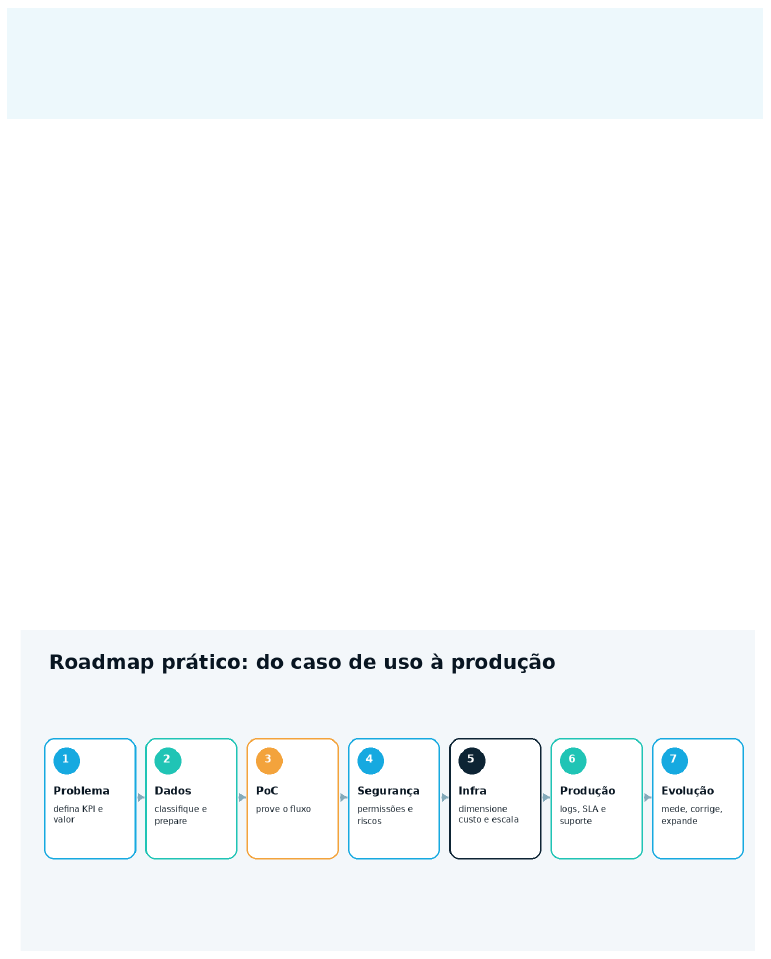
Many AI initiatives fail not because the model is incapable, but because the problem was poorly defined. A PoC should exist to test specific hypotheses: minimum quality, integration, latency, cost, security, and operational impact.
Start with a process that has an owner, data, and a metric. Design a human or current-system baseline. Then build a representative test set before choosing the final vendor. This avoids measuring quality based only on a few impressive demonstrations.
When moving to production, reassess infrastructure, governance, support, observability, and recovery. A notebook prototype is not an operational architecture. For critical systems, define SLO/SLA, capacity, contingency, prompt/model versioning, and rollback criteria.
Checklist before scaling an AI project:
- Are the problem and KPI clear?
- Is there sufficient and legally usable data?
- Are permissions defined?
- Is there a representative test set?
- Does the solution have observability?
- Is the cost per transaction acceptable?
- Is there a plan for failures, unavailability, and rollback?
- Does a business owner approve the outcome?
The AI landscape in 2026: scale, agents, and infrastructure
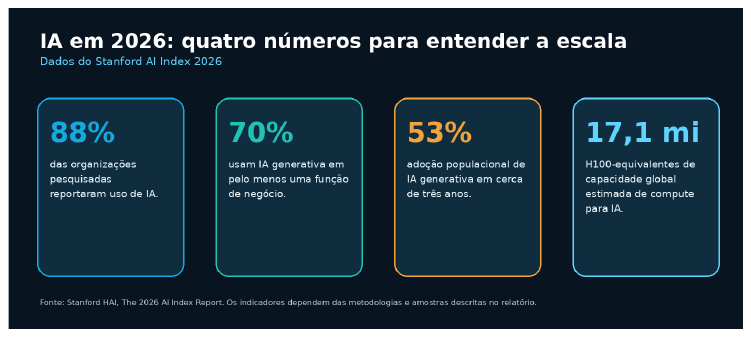
The Stanford AI Index 2026 shows that organizational adoption continues to grow and that generative AI already appears in business functions in a large share of the organizations surveyed. At the same time, the report highlights increased investment, accelerated expansion of computing capacity, and greater attention to governance.
This scenario suggests a shift in maturity. The first phase of generative AI was dominated by general-purpose chats. The second is being defined by integration: models connected to data, tools, corporate systems, and infrastructure optimized for cost and latency.
Agents are still in an early stage in many business functions, which is important: expectations should be calibrated. There is real value, but autonomous systems need to prove reliability. Competitive differentiation tends to shift from access to the same model toward data quality, integration, processes, experience, security, and operations.
For digital infrastructure companies, this creates a direct opportunity. AI increases demand for computing capacity, storage, connectivity, energy, resilience, and managed services. In other words: the growth of AI is also growth of the infrastructure needed to sustain it.
How EnQ Digital can support an AI journey
An enterprise AI strategy needs to connect application and infrastructure. EnQ Digital operates in digital infrastructure with Data Center, Virtual Cloud, Bare Metal, S3-compatible storage, connectivity, and associated services solutions. This makes it possible to design environments for traditional applications as well as emerging artificial intelligence workloads.
For an AI project, the discussion can start with the workload: model size, document volume, number of users, latency, availability, privacy, and expected cost. From there, it is possible to evaluate a cloud, bare metal, data center, or hybrid architecture.
The starting point does not need to be a gigantic cluster. Many companies generate value with existing models, RAG, and agents connected to their data. Infrastructure should grow according to demand and the criticality of the process.
- Virtual Cloud for applications, APIs, databases, and orchestration components.
- Dedicated Bare Metal for workloads that require predictable performance and direct hardware access.
- S3 Storage for data, documents, artifacts, backups, and datasets.
- Data Center and colocation for mission-critical environments and capacity expansion.
- Connectivity and security to integrate users, data, and AI services.
Essential AI glossary
| Term | Definition |
|---|---|
| AI Agent | System that uses a model to plan and execute actions with tools. |
| Algorithm | Procedure or set of rules for solving a problem. |
| API | Interface used by systems to exchange commands and data. |
| Attention | Mechanism that weighs relationships between different parts of a context. |
| Chunk | Passage into which a document is divided for indexing and retrieval. |
| Context window | Maximum number of tokens a model considers in an interaction. |
| Deep Learning | Machine learning based on deep neural networks. |
| Embedding | Vector representation that captures semantic relationships. |
| Fine-tuning | Additional adjustment of a model for specific behavior or domain. |
| GPU | Highly parallel processor used in many AI workloads. |
| Hallucination | Plausible output that is incorrect or unsupported by a reliable source. |
| Inference | Use of a trained model to produce a new output. |
| LLM | Large Language Model, a large-scale language model. |
| LLMOps | Practices for operating, evaluating, observing, and governing LLMs. |
| Machine Learning | Methods in which models learn patterns from data. |
| Model serving | Layer that makes a model available to receive requests. |
| Multimodal | Model capable of working with more than one modality, such as text and image. |
| Prompt | Instruction and context sent to a generative model. |
| Prompt injection | Attempt to alter or divert the system's instructions through malicious content. |
| Quantization | Reduction of numerical precision to decrease memory and computational cost. |
| RAG | Architecture that retrieves relevant sources before generating a response. |
| Reranker | Component that reorders retrieved results to improve relevance. |
| Reinforcement Learning | Learning through trial and error with rewards. |
| S3/Object Storage | Object storage useful for documents, datasets, and artifacts. |
| Token | Unit into which text is represented for processing by a model. |
| Transformer | Attention-based architecture, central to many modern models. |
| Vector database | System optimized for storing and searching vectors/embeddings. |
Frequently asked questions
What is artificial intelligence?
It is the field that develops systems capable of performing tasks associated with perception, language, learning, prediction, generation, or decision-making. AI is the broad field. Machine learning is an approach within AI in which models learn patterns from data.
What is generative AI?
It is the class of systems that creates new content, such as text, code, image, audio, or video, based on learned patterns.
What is an LLM?
It is a large language model trained to process and generate language sequences. Many current conversational assistants use LLMs.
What is RAG in artificial intelligence?
RAG is an architecture that searches for information in external sources and sends the relevant excerpts to the model before generating the response.
What are AI agents?
They are systems that combine models with tools, memory, and rules to execute multi-step tasks.
Does a company need to train its own model?
In most cases, no. Existing models, combined with RAG, fine-tuning, or tools, meet a large part of enterprise needs.
Does AI need a GPU?
Not always. Smaller models can run on a CPU. Large models, low latency, and high volume often benefit from GPUs or accelerators.
Is cloud or bare metal better for AI?
It depends on the workload profile. Cloud favors elasticity; bare metal can favor control and predictability; hybrid architectures combine both.
How can data be protected when using AI?
Classify data, define allowed providers and environments, apply encryption, access control, logs, data segregation, and response validation.
What is the first AI project for a company?
Start with a repetitive, measurable problem, with available data and low operational risk. Define the KPI before building the PoC.
How to measure the return on an AI project?
Compare the solution with the baseline using metrics such as time, cost, conversion, error, satisfaction, MTTR, availability, or volume processed.
Sources
- Alan M. Turing, Computing Machinery and Intelligence, Mind, 1950.
- McCarthy, Minsky, Rochester, and Shannon, A Proposal for the Dartmouth Summer Research Project on Artificial Intelligence, 1955.
- Krizhevsky, Sutskever, and Hinton, ImageNet Classification with Deep Convolutional Neural Networks, NeurIPS 2012.
- Vaswani et al., Attention Is All You Need, 2017.
- Google DeepMind, AlphaGo.
- OpenAI, Introducing ChatGPT, Nov. 30, 2022.
- Stanford HAI, The 2026 AI Index Report.
Editorial note: this material is informative. Market figures and references reflect the sources consulted and should be reviewed periodically, as the artificial intelligence sector changes rapidly.