
An NVIDIA Vera Rubin NVL72 is not just an ultra-high-density GPU rack. It is the core of an AI Factory: a platform that converts large volumes of data and electrical power into model training, inference, AI reasoning, scientific simulation and business outcomes at scale. This guide walks through the entire decision chain — from the business case to thermal and hydraulic sizing, CDU selection, commissioning and operation.
The chain is always the same: demand defines scale; scale defines power and thermal load; thermal load defines flow, ΔT and ΔP; and ΔP defines the pump, the CDU and the hydraulic plant. Skipping a step transfers uncertainty to the construction site, where correction costs more and compromises schedule.
About this material: the figures here are public platform and pre-design reference values. NVIDIA still classifies several Rubin specifications as preliminary. The Reference Design and the Site Planning Guide for the configuration actually purchased must take precedence over any preliminary calculation in this text.
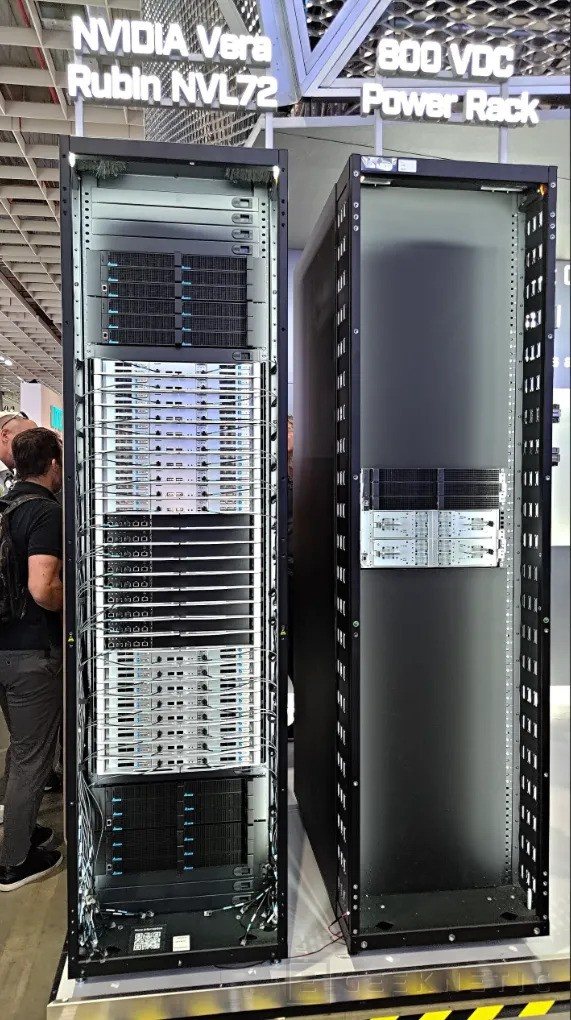
Executive summary
Each part answers a specific decision. Executives start with the first three lines; engineering moves through the technical disciplines; operations focuses on commissioning, telemetry and indicators; procurement uses the matrices and the RFI to structure quoting, technical equalization and acceptance.
| Part | Content | Main decision |
|---|---|---|
| Business case | When an AI Factory is justified | Build, rent GPU in the cloud, or hybrid? |
| Applications | Sectors, workloads and objectives | What workload will occupy the cluster? |
| Real cases | Blackwell GB200/GB300 in production | What economic model has already been validated? |
| Architecture | Rubin GPU, Vera CPU, HBM4, NVLink 6 | What does the rack deliver as a system? |
| Cooling | DLC, FWS, CDU, TCS and 45 °C | How does heat leave the chip and reach the atmosphere? |
| Sizing | kW, LPM, m³/h, ΔT, ΔP and Pump Head | What flow and pressure does the project require? |
| CDU selection | Criteria, DSX marketplace and manufacturers | Which CDU meets the actual operating point? |
| Electrical | Cabinet TDP, kVA and consumption | How much power and energy should be reserved? |
| Operation | BMS, commissioning, risks and RFI | How do you prove and sustain performance? |
Why build a supercomputer of this class
The central goal is to drastically reduce the time needed to train, fine-tune and run models and simulations that would be impractical on conventional infrastructure — while preserving low latency between GPUs, large aggregate memory and high efficiency per unit of work. The value is not just in the FLOPS.
- Time-to-solution: reducing weeks or months of training and simulation to days or hours.
- Larger models: training, fine-tuning and serving LLMs, multimodal models and Mixture-of-Experts with hundreds of billions or trillions of parameters.
- Reasoning at scale: sustaining inference with long context, agents and reasoning chains that consume far more compute than a traditional chatbot.
- Sovereignty and privacy: keeping data, models and intellectual property within infrastructure controlled by the organization or the country.
- AI + HPC convergence: using the same factory for AI, massive data analysis, numerical simulation and scientific workloads.
- Per-token economics: in large, continuous workloads, performance per watt, utilization and communication speed determine TCO.
- Monetization: cloud providers and data centers can turn the infrastructure into GPU-as-a-Service, training-as-a-service and inference-as-a-service.
When it makes sense — and when it doesn't
An NVL72 cluster is justified when there is sustained demand for parallel computing, large datasets, strong GPU-GPU communication, a need for low latency, data sovereignty, or an inference volume sufficient to amortize the infrastructure. For small, experimental projects or those with sporadic utilization, public cloud or smaller clusters tend to offer a better economic fit.
| Indicator | Signal that an AI Factory may make sense |
|---|---|
| Training | Large proprietary models, recurring training or continuous fine-tuning. |
| Inference | Billions of tokens/day, low latency and agents executing complex workflows. |
| Data | Petabytes or strategic datasets that must not leave the controlled domain. |
| HPC | Highly parallel simulations: CFD, FEA, climate, molecular dynamics or seismic. |
| Business | Capacity used continuously or resold as a GPU/AI service. |
| Sovereignty | Data residency, security, compliance or intellectual property requirements. |
Which areas the platform is useful for
The same infrastructure serves generative AI and HPC. The gain appears mainly when the problem can be parallelized and requires large memory bandwidth and communication between accelerators.
| Area | Typical workloads | Objective |
|---|---|---|
| AI Labs / LLM | Foundation models, MoE, multimodal, reasoning, fine-tuning and RL. | Create proprietary models and reduce training time. |
| Cloud / Data Center | GPUaaS, bare metal GPU, inference endpoints, dedicated clusters. | Monetize capacity and serve AI/HPC customers. |
| Banking and finance | Fraud, AML, risk, pricing, tabular models, agents and document analysis. | Process large datasets and run private AI with low latency. |
| Healthcare and life sciences | Drug discovery, molecular dynamics, genomics, protein design and medical imaging. | Shorten research cycles and test more hypotheses. |
| Industry and engineering | CFD, FEA, digital twins, generative engineering, robotics and industrial vision. | Reduce physical prototyping and speed up optimization. |
| Energy, oil and gas | Seismic imaging, reservoir simulation, grid optimization and predictive maintenance. | Increase resolution and reduce operational decision time. |
| Climate and environment | Weather forecasting, climate modeling and data assimilation. | Run faster, higher-resolution forecasts. |
| Telecom | RF planning, network optimization, AI for NOC and traffic models. | Automate operations and predict congestion and failures. |
| Government / Sovereign AI | National LLMs, research, cyber defense and public services. | Preserve data sovereignty and strategic AI capacity. |
| Cybersecurity | Large-scale detection, malware analysis and SOC with agents. | Correlate large volumes of telemetry and accelerate response. |
| Media and content | Video, image, audio generation, translation and neural rendering. | Produce multimodal content at large scale. |
| Scientific research | Physics, chemistry, materials, astronomy, bioinformatics and hybrid methods. | Explore solution spaces previously unfeasible due to computational cost. |
Practical example: an institution can use the same cluster during the day for inference and corporate agents and, in planned windows, allocate thousands of GPUs for training, simulation or scientific processing via Kubernetes/Slurm. The value comes from shared utilization and the ability to orchestrate distinct workloads.
Real cases with Blackwell B200 and GB200 NVL72
Blackwell systems that predate Rubin already demonstrate how an AI Factory is used in production. These cases help clarify the type of workload and the economic model that Vera Rubin tends to expand.
Naming: B200 and B300 refer to the Blackwell and Blackwell Ultra GPU generations. GB200 and GB300 combine Grace CPU + Blackwell GPU in the Superchip and, in the NVL72, form the rack-scale system with 72 GPUs.
| Case | System | What it demonstrates |
|---|---|---|
| CoreWeave | GB200 NVL72 | In April 2025, NVIDIA announced thousands of active Grace Blackwell GPUs; Cohere, IBM and Mistral AI began training and serving reasoning and agentic AI models. |
| Oracle / OCI | GB200 NVL72 liquid-cooled | First wave of racks in operation, with thousands of Blackwell GPUs for OCI and DGX Cloud, combining Quantum InfiniBand and Spectrum-X Ethernet. |
| NeoSpace | GB200 NVL72 via OCI | Latin American case: NeoData in a multi-cloud environment for one of the largest private banks in Latin America, with more than 60 million customers. |
| DeepL | GB200 | Training of next-generation Mixture-of-Experts models, seeking efficiency in both training and inference. |
| Microsoft / OpenAI | GB300 NVL72 | Large-scale Azure cluster: throughput, latency, memory and network scaling as a single system. |
| Lambda | GB300 NVL72 | AI Factory of more than 100 MW in Kansas City, planned with more than 10,000 GPUs — energy and data center turned into sellable capacity. |
| Together AI / 5C | B200, GB200 and GB300 | AI Factory in Maryland with B200 and a new facility in Memphis with GB200/GB300 for AI-native applications. |
| Global AI | 128 GB300 NVL72 racks | More than 9,000 GPUs in New York: the rack stops being an isolated unit and becomes a repeatable block of an AI Factory. |
What these cases teach: the goal is not simply owning GPUs. Value appears when compute, NVLink, scale-out networking, storage, software, power and cooling are treated as a single factory capable of delivering tokens, training, simulations and services with operational predictability.
Why Vera Rubin is the next step
In 2026, NVIDIA reported that the Vera Rubin NVL72 entered production ramp, with racks operating at partners such as CoreWeave, Google Cloud, Microsoft Azure, Oracle Cloud Infrastructure and Nebius. Microsoft announced Rubin for future Fairwater sites, while CoreWeave began integrating Rubin systems for training, inference and agentic AI workloads.
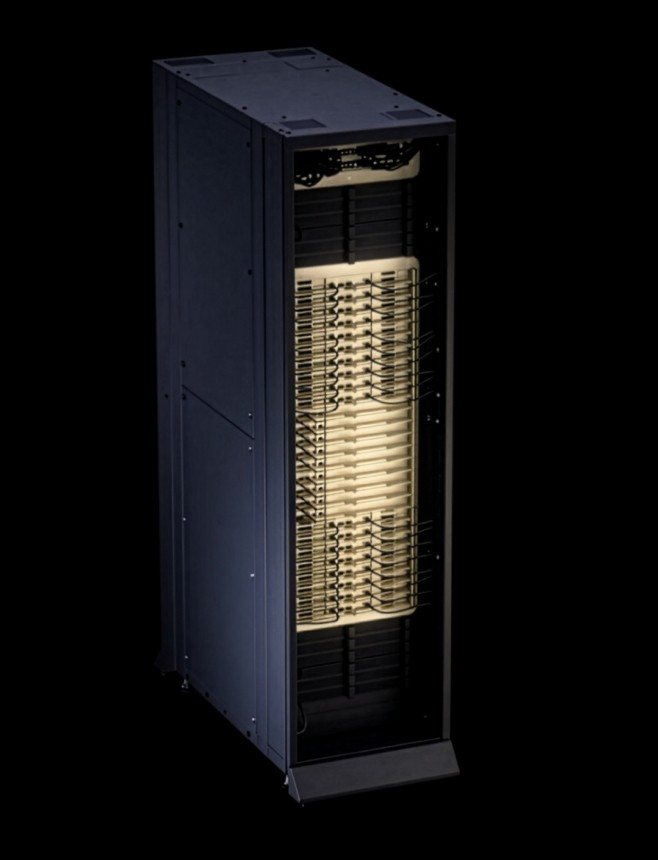
Executive message: Vera Rubin should be understood as strategic infrastructure for the AI Factory and HPC — high CAPEX and high density, but able to concentrate in a few racks a capacity that conventional servers cannot match.
Systemic architecture of the AI Factory
Vera Rubin is a rack- and POD-scale AI infrastructure architecture designed so that computing, memory, communication, networking, storage, security, power and cooling function as a coordinated system. In current models, performance does not depend only on FLOPS: it is necessary to move weights, activations and KV cache, synchronize accelerators, maintain low latency and deliver more tokens per watt.
The strategic shift is clear: from an isolated server to a rack-scale execution domain; from peak FLOPS to useful tokens per watt and per megawatt; from pure training to training, post-training and agentic inference; from peripheral interconnect to memory and communication as part of the accelerator.
The platform brings together Rubin GPU, Vera CPU, NVLink 6 Switch, ConnectX-9 SuperNIC, BlueField-4 DPU and new networking families and specialized racks — compute, CPU, storage and Ethernet. The NVL72 is the compute core of this ecosystem.
The Rubin GPU in detail
The Rubin GPU is oriented toward reasoning, generation, data retrieval and tool-use workloads. The combination of HBM4, Transformer Engine and NVLink 6 aims to keep accelerators busy even in workloads with intensive communication and multiple inference steps.
| Item | Rubin GPU | Vera Rubin NVL72 |
|---|---|---|
| Transistors | 336 billion | — |
| SMs / Tensor Cores | 224 / 896 | 72 GPUs |
| NVFP4 inference | 50 PFLOPS | 3,600 PFLOPS |
| Memory | 288 GB HBM4 | 20.7 TB HBM4 |
| HBM4 bandwidth | 22 TB/s | 1,580 TB/s aggregate |
| Interconnect | NVLink 6: 3.6 TB/s | 260 TB/s per rack |
Correct interpretation: the values above are specifications and peaks published for the platform. Application performance depends on framework, kernel, precision, model, batch, context and parallelism strategy.
HBM4 memory and NVLink 6
In inference, especially during the decode phase, moving weights and model state can be just as decisive as running multiplications. That is why Vera Rubin combines memory capacity, large bandwidth and a low-latency communication fabric.
- Up to 288 GB of HBM4 per Rubin GPU and up to 22 TB/s of memory bandwidth per GPU.
- More room for weights, activations, KV cache and concurrency, with less need to offload state to slower tiers.
- Up to 3.6 TB/s of scale-up per GPU for the NVLink domain, with all-to-all communication among the GPUs in the NVL72.
- High-bandwidth NVLink-C2C for coherent CPU-GPU communication.
- Reduced synchronization overhead and less time lost in transfers for MoE and distributed workloads.
Why this matters: Mixture-of-Experts models distribute tokens across experts. The more time the rack spends transferring weights and synchronizing GPUs, the smaller the fraction of energy converted into useful work. HBM4 and NVLink 6 directly attack this bottleneck.
Training, inference and agentic AI
An agent does not just answer a question: it plans, calls tools, consults sources, verifies results, and can generate several token sequences before completing a task. This increases the inference volume and makes per-step latency critical.
| Training | Inference and agentic AI |
|---|---|
| Large-scale MoE and foundation models. | Interactive services with low latency. |
| Tensor, pipeline and expert parallelism. | Long-context and large KV caches. |
| High communication for synchronization and token routing. | High concurrency and continuous batching. |
| HBM4 to keep parameters and states close to compute. | Optimization for tokens/s, tokens/W and cost per million tokens. |
In specific scenarios, NVIDIA positions Vera Rubin to deliver significant gains in tokens per megawatt and cost per million tokens compared to previous generations. Treat these figures as platform reference values, conditioned on model, software, precision and configuration.
Networking, storage and security
The platform does not end at the GPU. To keep 72 accelerators busy, east-west traffic, storage access and workload protection need to be treated as parts of the computer.
- Networking: ConnectX-9 SuperNIC for ultra-high-bandwidth scale-out; Quantum-X800 InfiniBand and Spectrum-X Ethernet for multi-rack clusters; RDMA and low-latency paths; spine-leaf architectures and high-density optics sized alongside the compute.
- Contextual storage: the BlueField-4/STX architecture extends the role of storage beyond a file repository, bringing context and KV cache layers closer to the execution domain — combined, in real projects, with NVMe, parallel file systems, object storage and tiering policies.
- Security: BlueField-4 for network processing, offload and policies; Confidential Computing and protection of data in use, in transit and at rest as supported by the platform; tenant isolation in cloud and GPUaaS; secure boot, signed firmware, observability and rack-scale RAS.
Vera Rubin versus Blackwell
The comparison should be made at the system level. Rubin is not just a GPU update: it changes how the data center delivers computing for AI, with new demands on memory, networking, power and cooling.
| Criterion | Blackwell / GB200 | Vera Rubin / NVL72 |
|---|---|---|
| Focus | Training and inference at scale | Agentic AI, long-context and efficiency |
| Memory | HBM3e, depending on model | HBM4, up to 288 GB/GPU |
| Interconnect | NVLink 5 | NVLink 6 |
| Reference rack | GB200 NVL72 | Vera Rubin NVL72 |
| Cooling | Direct liquid cooling | Direct liquid cooling, integrated rack |
| Economics | High throughput | Focus on tokens per watt and per MW |
Technical view of the rack
The NVIDIA Vera Rubin NVL72 is a third-generation MGX rack-scale system. The rack integrates 72 Rubin GPUs and 36 Vera CPUs, interconnected via NVLink 6, with ConnectX-9 and BlueField-4 networking. The goal is to make the rack operate as one large single accelerator within the AI Factory.
| Parameter | Reference |
|---|---|
| GPUs | 72 × NVIDIA Rubin |
| CPUs | 36 × NVIDIA Vera |
| Total HBM4 | 20.7 TB |
| HBM4 bandwidth | up to 1,580 TB/s |
| CPU memory | 54 TB LPDDR5X |
| Total DGX fast memory | 75 TB |
| NVLink | 6th generation |
| NVLink switch system | 9 × L1 NVLink Switch Units |
| Scale-out | ConnectX-9 / BlueField-4 |
| Facilities Cabinet TDP | up to 330 kW — DSX reference |
Physical structure: 18 compute trays and 9 NVLink 6 switch trays. Each compute tray integrates 2 Vera Rubin Superchips, totaling 4 Rubin GPUs and 2 Vera CPUs. The tray design is modular, cable-free, hose-free and fanless, with a redesigned internal manifold. The third-generation MGX rack uses UQD08 rack manifolds and liquid-cooled busbars for high currents.
Specification of each compute tray
The compute tray is the service and calculation unit repeated 18 times in the rack. Each tray concentrates compute, networking, cooling, management and power delivery.
| Item | Per compute tray |
|---|---|
| Vera Rubin Superchips | 2 |
| Rubin GPUs | 4 |
| Vera CPUs | 2 |
| Total HBM4 | 1,152 GB (4 × 288 GB) |
| HBM4 bandwidth | 88 TB/s aggregate |
| CPU cores | 176 Olympus cores |
| CPU memory | up to 3 TB LPDDR5X |
| NVFP4 inference | 200 PFLOPS per tray |
| NVLink 6 | 14.4 TB/s aggregate |
| Networking | ConnectX-9 + BlueField-4 |
| Cooling | Direct Liquid Cooling, fanless tray |
Attention to power per blade: the public documentation details tray capacity and architecture, but the definitive electrical Max Power/TDP per compute tray must be obtained from the final Site Planning/Reference Design. Do not derive the electrical circuit simply by dividing 330 kW by 18.
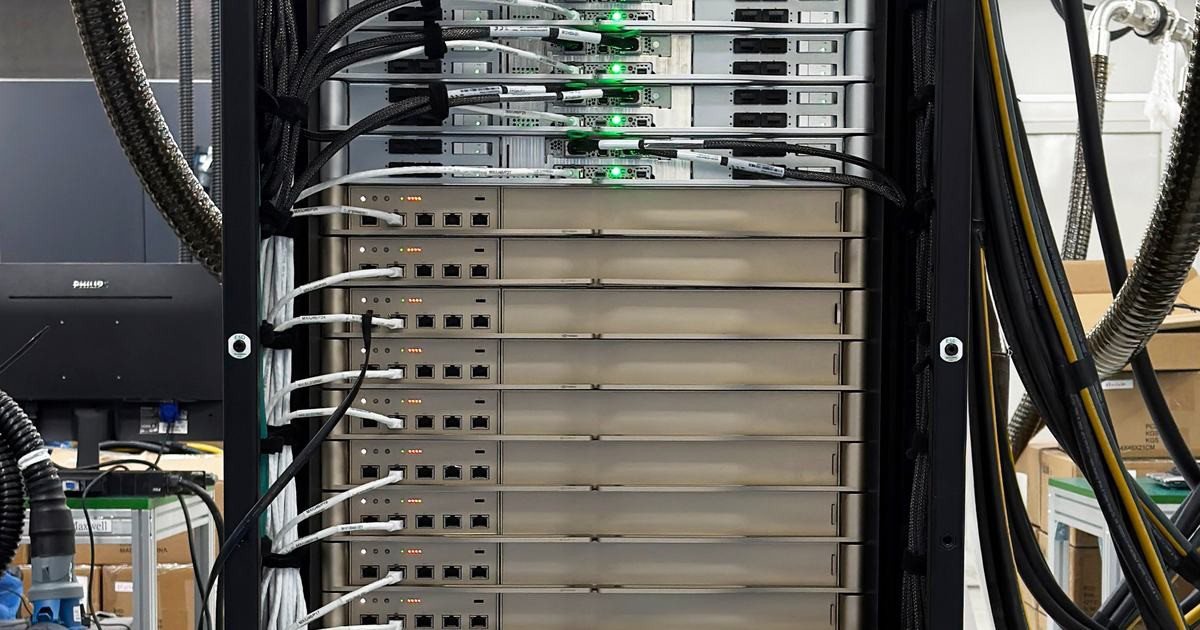
Facilities executive summary
The Vera Rubin NVL72 represents a change in scale in the design of physical infrastructure for AI. For facilities, the NVIDIA DSX reference evolves to a Cabinet TDP of up to 330 kW per rack and to a high-temperature liquid cooling strategy.
| Base parameter for pre-design | Reference value |
|---|---|
| DSX Cabinet TDP | 330 kW per rack |
| TCS design flow | ≥ 1.5 LPM/kW |
| Reference flow per rack | ≥ 495 LPM (29.7 m³/h) |
| CDU type | Liquid-to-liquid |
| CDU redundancy | N+1 |
| Cooling design point | 45 °C |
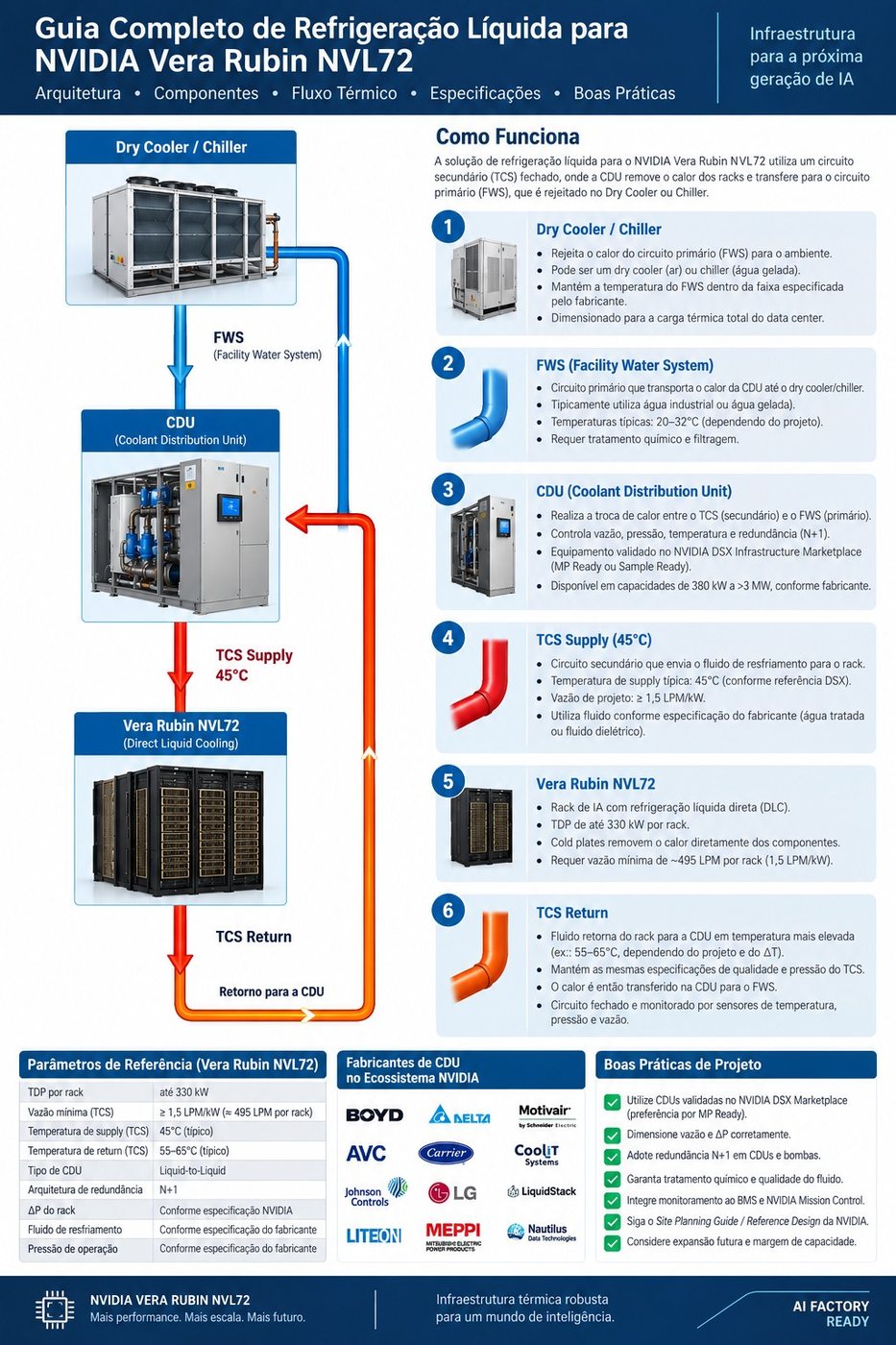
DLC architecture: FWS, CDU, TCS and rack
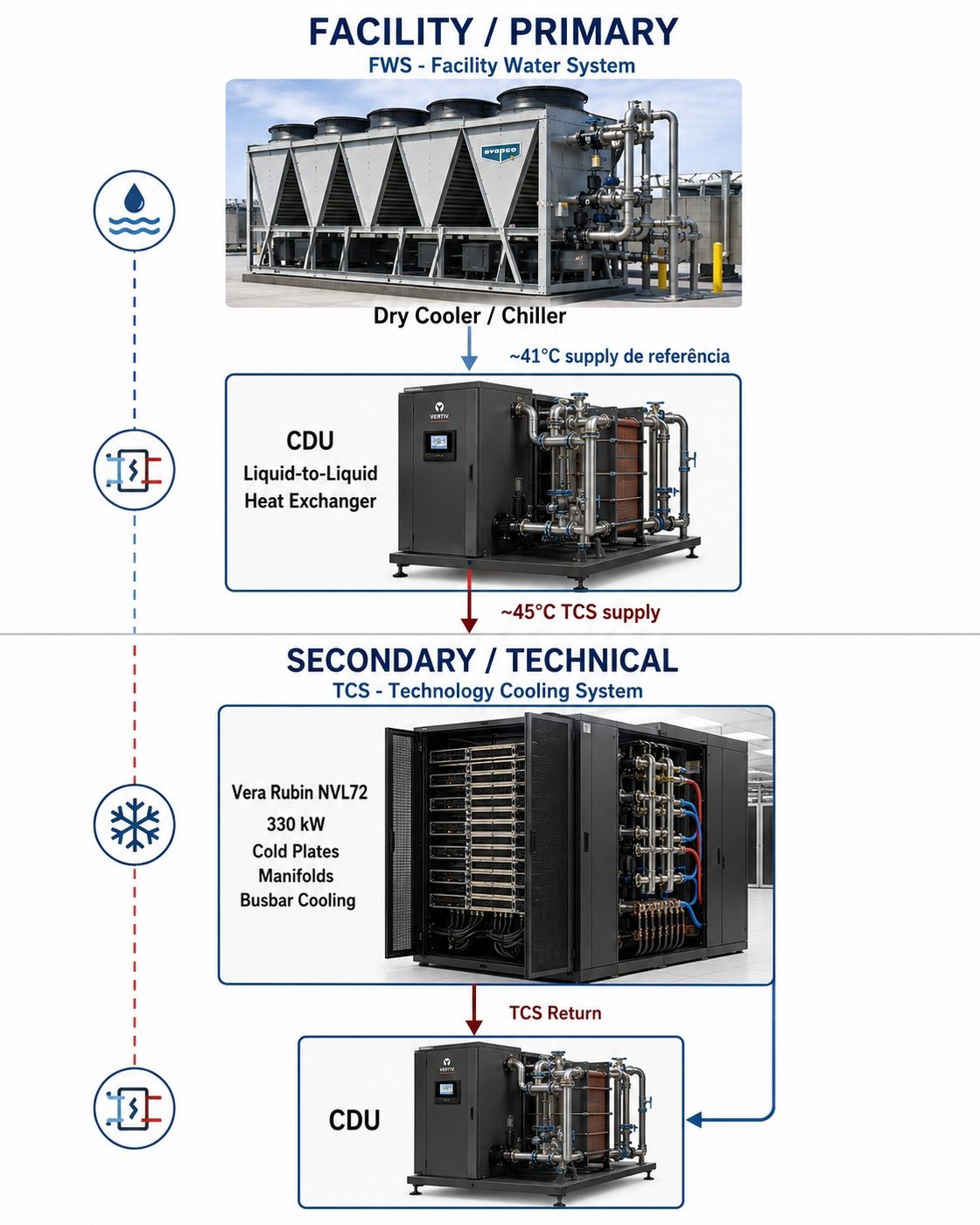
The solution uses two hydraulic circuits separated by a heat exchanger. Understanding this separation is what avoids the project's most costly mistakes.
What FWS, CDU and TCS are
FWS — Facility Water System. This is the data center's primary circuit. It carries heat between the CDUs and the heat rejection plant — typically chillers, dry coolers, pumps and heat exchangers in the Central Utility Building. FWS must not be confused with the technical fluid that circulates inside the racks. It typically uses industrial water or chilled water, with temperatures in the range of 20–32 °C depending on the project, and requires chemical treatment and filtration.
CDU — Coolant Distribution Unit. This is the thermal and hydraulic interface between the FWS and the TCS. In a liquid-to-liquid CDU, a heat exchanger keeps the two circuits separated. The CDU controls temperature, flow, pressure and differential pressure, and normally includes redundant pumps, filtration, sensors, controls and BMS integration. It is available in capacities from 380 kW to more than 3 MW depending on the manufacturer.
TCS — Technology Cooling System. This is the secondary, technical-quality circuit that leaves the CDU and directly feeds the manifolds and cold plates of the IT equipment. For the Vera Rubin project, the TCS must be sized based on the rack's thermal and hydraulic operating point, not just the CDU's nominal kW capacity.
Rule of thumb: FWS = facility water | CDU = separation and control | TCS = technical fluid reaching the rack | DLC = heat removal directly at the chip.
45 °C cooling: why this changes the data center
NVIDIA describes MGX racks as designed to operate with a 45 °C warm-water inlet. In a reference scenario, facility water on the order of 41 °C feeds the CDU, which supplies approximately 45 °C to the rack. The goal is to widen the heat rejection window without continuously relying on mechanical compression.
- Greater possibility of dry cooling and free cooling in various climates.
- Lower compressor consumption and potential PUE reduction.
- More of the site's electrical budget can be directed to compute.
- The liquid-to-liquid architecture allows IT fluid quality to be separated from facility water.
- 45 °C is a design point: final temperatures, approach and limits must come from the contracted design.
Do not confuse: a 45 °C TCS supply does not mean the Facility Water necessarily enters the CDU at 45 °C. The CDU requires a thermal difference (approach), and the FWS/TCS design must be verified with the manufacturer.
Thermal and hydraulic sizing
DSX states that the Cabinet TDP scales up to 330 kW for the Vera Rubin NVL72. For cooling pre-design, this is the most consistent reference value for sizing heat rejection, CDU and distribution, until the final Site Planning indicates specific MaxP/MaxQ values. DSX further defines a TCS design flow of at least 1.5 LPM/kW.
Per-rack calculation: 330 kW × 1.5 LPM/kW = 495 LPM = 29.7 m³/h per Vera Rubin NVL72.
| Racks | Thermal load | Minimum TCS | Flow |
|---|---|---|---|
| 1 | 330 kW | 495 LPM | 29.7 m³/h |
| 2 | 660 kW | 990 LPM | 59.4 m³/h |
| 4 | 1.32 MW | 1,980 LPM | 118.8 m³/h |
| 8 | 2.64 MW | 3,960 LPM | 237.6 m³/h |
| 16 | 5.28 MW | 7,920 LPM | 475.2 m³/h |
ΔT: turning kW and flow into temperatures
The thermal balance of a water circuit can be approximated by Q = ṁ × Cp × ΔT. In water, 495 LPM is equivalent to approximately 8.25 kg/s. For 330 kW, the theoretical ΔT is on the order of 9.6 °C.
Illustrative example: if the TCS enters at 45 °C and removes 330 kW at about 495 LPM with properties close to those of water, the theoretical return would be close to 54–55 °C. This value is merely indicative; the coolant and final temperatures must follow the OEM and the CDU.
- A higher ΔT can reduce the flow required for the same load, but must respect the rack's limits.
- Higher glycol concentration alters density, viscosity and thermal capacity.
- A CDU's published capacity depends on the approach temperature and the operating point.
- Use the manufacturer's curves, not just the nominal catalog power.
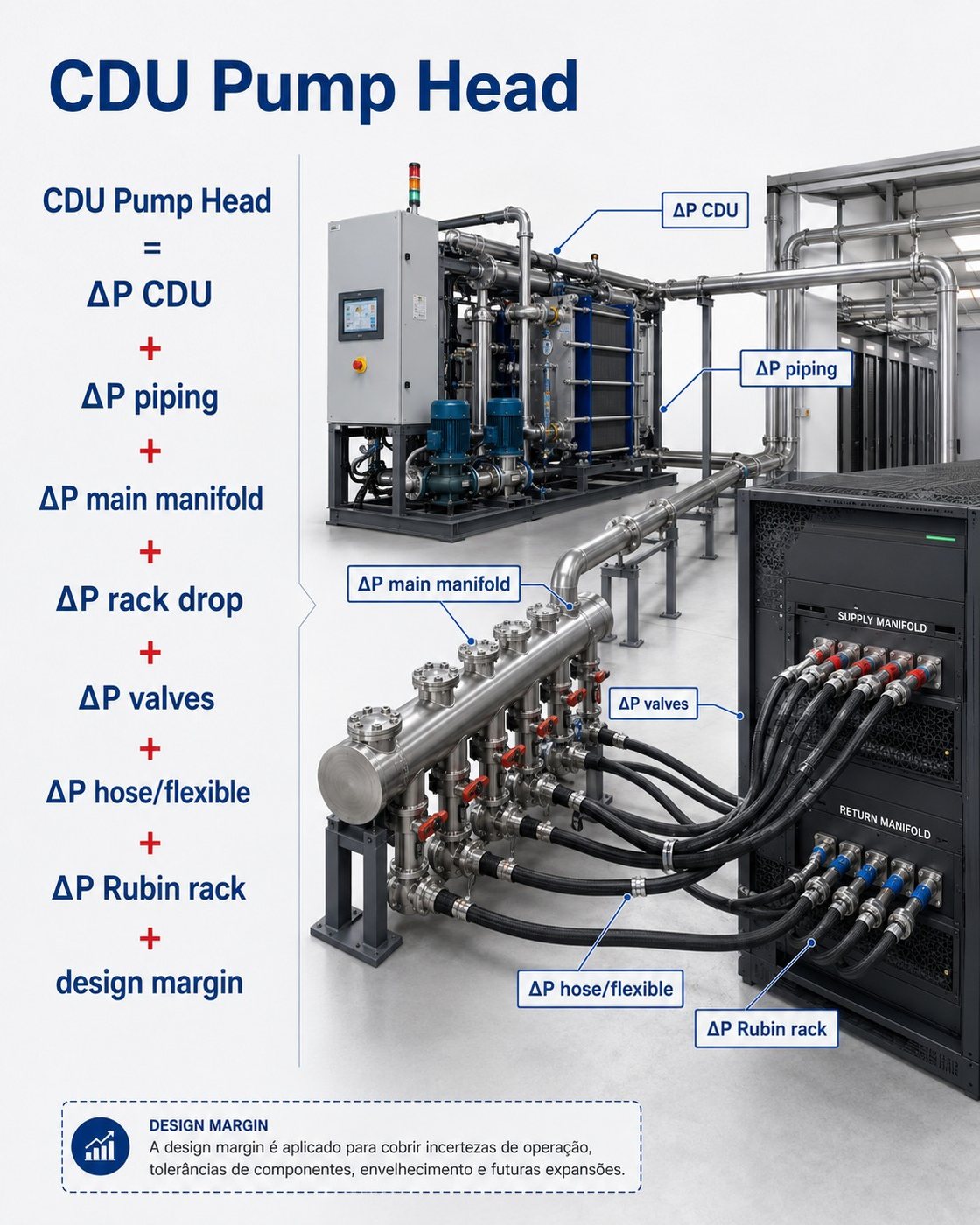
How to interpret ΔP and the Pump Head
ΔP reads "Delta P" and means pressure difference. In a hydraulic circuit, it represents the pressure loss between two points. If the rack receives 3.0 bar and returns 2.2 bar, the rack's ΔP is 0.8 bar.
Total Pump Head: ΔP CDU + ΔP piping + ΔP main manifold + ΔP rack drop + ΔP valves + ΔP hose/flexible + ΔP Rubin rack + design margin.
The CDU pump must supply sufficient flow at the required Pump Head. A CDU rated at many megawatts may not meet the project if its pump curve does not deliver the necessary flow at the circuit's actual ΔP.
- Obtain the rack's ΔP from the OEM at nominal and maximum flow.
- Calculate the head losses of the supply and return headers.
- Add valves, filters, fittings, flexibles, manifolds and accessories.
- Apply a consistent margin for tolerances, aging, fouling and expansion.
- Check NPSH, cavitation and parallel pump operation where applicable.
Manifolds, cold plates and the rack interface
In the third-generation MGX, NVIDIA describes new internal tray manifolds, UQD08 rack manifolds, and liquid-cooled busbars capable of supporting very high currents. The compute tray was redesigned into a cable-free, hose-free and fanless assembly.
- The supply manifold distributes coolant across the trays; the return manifold collects the heated fluid.
- Universal Quick Disconnects (UQD08) facilitate connection and maintenance.
- Cold plates transfer heat directly from the GPU, CPU and other components to the fluid.
- The rack's external interface — diameter, connection standard, working pressure and position — must come from the OEM's mechanical drawing.
Mandatory project information: do not assume that the internal UQD08 connector is the same as the rack's external connector. Request the Rack Supply/Return Interface Drawing with the number of connections, diameter, type, height, orientation, pressure and insulation requirements.
How to select the CDU
Selection should not be based solely on "CDU MW." It is necessary to simultaneously validate thermal capacity, flow, available pressure, approach, fluid, materials, redundancy, power supply and controls.
| Criterion | What to validate |
|---|---|
| Thermal capacity | ≥ rack load at the defined operating point and ATD |
| Secondary flow | ≥ 1.5 LPM/kW as a DSX reference |
| Pump Head | Sufficient for the calculated total ΔP |
| Type | Liquid-to-liquid per DSX reference |
| Redundancy | N+1 in CDU groups |
| Pumps | Redundancy, failover and validated curve |
| Fluid and materials | Chemical compatibility and wetted materials |
| Filtration | Rating compatible with the OEM |
| Controls | Constant flow or constant ΔP depending on strategy |
| Integration | BMS, DSX Exchange and Mission Control |
| Maintenance | Isolation, bypass and swap without undue impact |
Example: for 1 rack, that is 330 kW and ≥ 495 LPM. A nominal 380 kW / 600 LPM CDU may seem sufficient, but the decision is only valid if it delivers those values at the project's actual ΔP and approach.
DSX Marketplace: MP Ready vs Sample Ready
The NVIDIA DSX Infrastructure Marketplace publishes CDUs submitted to the CDU Self-Qualification Suite and indicates supply chain status. MP Ready is not, by itself, synonymous with qualification: it is an indicator of readiness for mass production, while the Validation Type column shows the technical tests performed.
| Status | Practical meaning |
|---|---|
| MP Ready | Mass Production Ready: product at a scale-supply stage. |
| Sample Ready | Product available at a sample/qualification stage, without the same mass production status yet. |
| Validation Type | Lists the tests performed: hydraulic constant flow/DP, thermal capacity, pump failover, flow accuracy, group control and others. |
Published tests include Hydraulic Test (Constant Flow and Constant DP), Pumping Capacity, Thermal Test (Nominal Capacity and Low Load), Flow Sensor Accuracy, Cold Start Test, Pump Failover, Group Control and Wetted Materials Compatibility.
CDU manufacturers in the DSX ecosystem
The public list is dynamic. The values below reflect the query performed on 09/04/2026 and should be reconfirmed before purchase.
| Manufacturer | Model | Capacity @ 4 °C ATD | Flow @ 35 psi | Status |
|---|---|---|---|---|
| AVC | CDU1000-LTL-RW | 1.2 MW | 1,600 LPM | Sample Ready |
| Boyd | ROL2300 | 1.1 MW | 2,600 LPM | MP Ready |
| Carrier | 65LL | 1.2 MW | 2,500 LPM | Sample Ready |
| CoolIT | CHx1500 | 1.5 MW | 1,950 LPM | — |
| Delta | RDF106CDT5192 | 1.0 MW | 1,500 LPM | MP Ready |
| Delta | CDU3000 | 2.0 MW | 3,200 LPM | — |
| Johnson Controls | SACDU-1050 | 1.0 MW | — | — |
| LG Electronics | LGE | 600 kW | 850 LPM | — |
| LiquidStack | L2L CDU800 | 800 kW | 1,200 LPM | — |
| LiquidStack | D1PM20 | 2.5 MW | 3,750 LPM | — |
| LITEON | LC-LL-WCDU-6011(S) | 380 kW | 600 LPM | Sample Ready |
| MEPPI | ME-CDU 1200 | 1.25 MW | — | — |
| Motivair | MCDU50 | 1.7 MW | 1,136 LPM | MP Ready |
| Motivair | MCDU55 | 1.3 MW | 1,616 LPM | Sample Ready |
| Nautilus | EcoCore FCD | 3.6 MW | 3,300 LPM | — |
Procurement strategy in Brazil
For deployment in Brazil, it is advisable to separate three criteria: the manufacturer's local presence, availability of the exact model, and the model's validation status within the NVIDIA ecosystem. A company may have a Brazilian operation without keeping the specific Rubin project CDU in local stock.
| Manufacturer / ecosystem | Public evidence in Brazil | Note |
|---|---|---|
| Schneider Electric / Motivair | Brazilian portfolio of liquid cooling and CDUs | Publishes Motivair CDUs and local services; validate the specific DSX model. |
| Delta Electronics | GoCool LTL on the Brazilian site | GoCool-1000/1200/1500/3000; validate equivalence and the exact model's status in DSX. |
| Johnson Controls / Silent-Aire | Brazilian data center and liquid cooling page | Good service presence; validate SACDU, model and lead time. |
| Carrier | Regional/global presence and CDU 65LL | Confirm local availability and supply chain status. |
| LG | Local operation | Confirm CDU model, support and BOM for Rubin. |
Purchasing recommendation: issue an RFI/RFQ to at least three suppliers and require pump curves, thermal maps by ATD, wetted materials, coolant quality, redundancy, BMS integration, FAT/SAT, spare parts and a support commitment in Brazil.
Electrical power, kVA and consumption
DSX publishes 330 kW as the Cabinet TDP. For an approximation of electrical infrastructure, kVA = kW / power factor. Final sizing, however, must use the electrical site planning and the rack's power supply limits, not just the thermal TDP.
| Power factor | Calculation | Equivalence |
|---|---|---|
| PF 0.95 | 330 kW / 0.95 | 347.4 kVA |
| PF 0.98 | 330 kW / 0.98 | 336.7 kVA |
| PF 0.99 | 330 kW / 0.99 | 333.3 kVA |
NVIDIA does not publish a universal average consumption figure for Rubin. Training, inference, communication and MaxP/MaxQ profiles produce different loads. Use utilization scenarios only for energy budgeting, never to reduce installed physical capacity.
| Scenario | Average power | Energy over 730 h |
|---|---|---|
| 50% of envelope | 165 kW | 120.5 MWh/month |
| 70% | 231 kW | 168.6 MWh/month |
| 80% | 264 kW | 192.7 MWh/month |
| 90% | 297 kW | 216.8 MWh/month |
| 100% | 330 kW | 240.9 MWh/month |
Integrated requirements for the data center
| Domain | Points to validate |
|---|---|
| Space | U occupied, weight, access, movement path, floor and maintenance area. |
| Power | kW/kVA per rack, A/B architecture, UPS, PDU, protection, grounding, harmonics and expansion. |
| Thermal | CDU, flow, ΔP, supply/return, temperature, fluid quality and leak detection. |
| Network | InfiniBand/Ethernet, fiber, transceivers, latency, cabling and spine-leaf. |
| Storage | NVMe, parallel file system, object storage, throughput and metadata. |
| Operations | NOC, DCIM/BMS, telemetry, spare parts, training, RMA and emergency procedures. |
Receiving checklist: confirm model and revision; obtain dimensional and weight drawing; request Max-P/TDP, nominal, minimum and maximum flow and ΔP; validate supply/return and CDU; perform FAT/SAT, hydraulic test, load test and network validation.
BMS, Mission Control and observability
Cooling for an AI Factory needs to be observable in real time. The DSX documentation publishes a catalog of points for integration between the BMS and the NVIDIA/DSX Exchange ecosystem.
| Point | Operational use |
|---|---|
| CDULiquidSupplyTemperature | TCS supply temperature |
| CDULiquidReturnTemperature | TCS return temperature |
| CDULiquidDifferentialPressure | ΔP of the secondary circuit |
| CDULiquidFlow | Flow in LPM |
| CDULiquidSystemPressure | System and return pressure |
| Leak detection / alarms | Leak events and abnormalities |
| CDU availability/status | Availability and operational state |
- Alarms for out-of-range temperature, flow, ΔP and pressure.
- Historical trending to detect fouling, saturated filters and pump degradation.
- Interlock and isolation logic per cause-and-effect matrix.
- Integration of facility events with Mission Control/DSX for coordinated power and cooling operation.
Technical RFI: 12 mandatory pieces of information
Before the executive design, these twelve pieces of information must come from the manufacturer or the representative — not from an estimate.
| # | Information | Why it is indispensable |
|---|---|---|
| 1 | Exact quantity of Vera Rubin NVL72 | Defines total scale, power, cooling, flow, CDU, redundancy and expansion. |
| 2 | Confirmed Max-P/TDP per rack | Basis for power and thermal load, within the contracted operational profile. |
| 3 | TCS design flow per rack | Nominal flow to remove the load and size pumps, headers and CDU. |
| 4 | TCS minimum/maximum flow | Operational limits against underflow, excess flow and operation outside the envelope. |
| 5 | TCS supply/return temperatures | Determines ΔT, CDU approach, thermal efficiency and rejection capacity. |
| 6 | Rack ΔP at nominal and maximum flow | Needed to calculate Pump Head and select pumps and valves. |
| 7 | Working pressure and maximum allowable pressure | Defines circuit safety limits, hoses, valves and fittings. |
| 8 | Coolant / water-quality specification | Specifies fluid, chemistry, pH, conductivity, filtration and compatible materials. |
| 9 | Rack Supply/Return connection type and dimensions | Defines diameter, type, position, quantity and standard of hydraulic interfaces. |
| 10 | CDU approved/validated models | Aligns selection with the DSX Marketplace and OEM configuration. |
| 11 | BMS/Mission Control telemetry requirements | Defines sensors, protocols, alarms and IT/OT integration points. |
| 12 | Final Site Planning Guide / Reference Design | Authoritative document for validating the executive design before deployment. |
Minimum package expected in the response: a filled-in table with nominal, minimum and maximum values and their units; hydraulic curves for the rack and the CDU at the relevant operating points; mechanical drawings of the supply/return interfaces; chemical specification of the coolant and wetted materials; a list of alarms, sensors, protocols and BMS/DSX integration points; and final Site Planning, FAT/SAT documents and acceptance criteria.
Pre-sizing example with 8 racks
This example is for initial sizing only. The executive design must finalize ΔP, pump curves, hydraulic topology, diversity, redundancy, expansion and the electrical envelope.
| Parameter | Pre-design value |
|---|---|
| Vera Rubin racks | 8 |
| Rubin GPUs | 576 |
| Vera CPUs | 288 |
| Aggregate Cabinet TDP | 2.64 MW |
| Minimum TCS design flow | 3,960 LPM |
| Equivalent flow | 237.6 m³/h |
| Cooling architecture | Liquid-to-liquid CDU group |
| CDU redundancy | N+1 |
| TCS supply design point | 45 °C class |
| BMS | Supply/return temp, flow, ΔP, pressure, alarms |
CDU selection: do not simply use 2.64 MW divided by nominal capacity. Also verify whether the CDU group delivers ≥ 3,960 LPM at the total Pump Head and thermal approach of the project, while maintaining N+1. For larger clusters, distribution should be designed as a high-capacity hydraulic plant, with main headers, per-rack and per-branch isolation, balancing, instrumentation and a concurrent maintenance strategy.
Commissioning and testing
A high-density DLC system must be commissioned as mission-critical infrastructure. The CDU FAT and the system SAT must validate not only thermal power, but also hydraulic and control behavior.
- Flushing and cleaning of piping before connection to the rack.
- Chemical analysis of the coolant and verification of compatible materials.
- Hydrostatic test according to allowable pressure and manufacturer procedure.
- Flow verification per branch and rack balancing.
- ΔP test at nominal and maximum load.
- Pump failover test and A/B power loss.
- Isolation and bypass valve test.
- Leak detection and cause/effect in the BMS.
- Validation of temperature, pressure and flow sensors.
- FWS loss test, recovery and restart sequence.
- N+1 operation test with one CDU unavailable.
- Baseline recording for operation and predictive maintenance.
Acceptance criteria: delivery must include as-built curves, control parameters, setpoints, alarm matrix, water-quality baseline, list of critical spare parts and a leak response procedure.
Main project risks
| Risk | Impact |
|---|---|
| CDU chosen only by MW | May lack flow or Pump Head at the actual operating point. |
| Unknown rack ΔP | Prevents correctly sizing the pumps. |
| Assumed rack connector | Can cause mechanical incompatibility and rework. |
| Undefined water quality | Risk of corrosion, fouling and cold plate failure. |
| No real N+1 | CDU maintenance or failure can affect multiple racks. |
| No per-rack isolation | Increases the blast radius of maintenance and leaks. |
| No adequate BMS/telemetry | Loss of early detection of degradation. |
| Using average consumption for sizing | Creates risk of insufficiency at MaxP. |
| Ignoring ATD/approach | The CDU's nominal capacity may not exist at the project's temperatures. |
| Not validating local availability | Risk of insufficient lead time, spare parts and support in Brazil. |
Quick glossary
| Term | Definition |
|---|---|
| DLC | Direct Liquid Cooling. |
| FWS | Facility Water System — the facility's primary circuit. |
| TCS | Technology Cooling System — the secondary circuit serving IT equipment. |
| CDU | Coolant Distribution Unit — the FWS/TCS interface with heat exchanger, pumps and controls. |
| ΔP | Delta P — pressure difference or loss between two points. |
| ΔT | Delta T — temperature difference between supply and return. |
| Pump Head | Pressure or manometric head that the pump must supply to overcome circuit losses. |
| Cold plate | Heat exchanger in thermal contact with the chip or component. |
| Manifold | Collector and distributor of supply and return. |
| UQD08 | Universal Quick Disconnect used in the third-generation MGX architecture. |
| ATD | Approach Temperature Difference of the heat exchanger or CDU. |
| MP Ready | Mass Production Ready — supply chain status on the NVIDIA DSX Marketplace. |
| Sample Ready | Sample and qualification stage on the Marketplace. |
| BMS | Building Management System. |
| DSX | NVIDIA architecture and ecosystem for the AI Factory, including facilities, hardware and IT/OT. |
Documents that should be requested
- NVIDIA Vera Rubin NVL72 Reference Design — NVOnline #1151654.
- NVIDIA DSX — Vera Rubin Facilities Infrastructure Reference Design — NVOnline #1145739.
- NVIDIA DSX Facilities Infrastructure Design Guide — NVOnline #1152370.
- Final Site Planning / Power & Cooling Specification for the acquired configuration.
- Rack Supply/Return Interface Drawing and coolant/water-quality specification.
Cut-off date: technical content and verified supplier list as of 09/04/2026. The NVIDIA DSX Marketplace is dynamic; revalidate status, capacity, flow and availability at the time of contracting.
Technical references
- NVIDIA Vera Rubin NVL72 — official specifications
- NVIDIA DGX Vera Rubin NVL72
- NVIDIA DSX Facilities Infrastructure Reference Design Overview
- NVIDIA DSX Infrastructure Marketplace — CDU
- NVIDIA Technical Blog — Vera Rubin POD
- NVIDIA Technical Blog — Inside the Vera Rubin Platform
- NVIDIA Mission Controls to BMS Data Catalog
- NVIDIA — Vera Rubin worldwide deployments
- NVIDIA — CoreWeave GB200 NVL72
- NVIDIA — Oracle OCI GB200 NVL72
- NVIDIA Case Study — NeoSpace / Finance
- NVIDIA — GB300 deployments and AI Infrastructure in America
Conclusion
The main innovation of Vera Rubin is systemic. The value is not in an isolated GPU, but in the combination of compute, HBM4, NVLink 6, scale-out networking, storage, security, power and Direct Liquid Cooling operating as a single computing factory.
For companies and data centers, the opportunity lies in transforming energy and physical infrastructure into useful AI capacity: model training, agentic inference, GPUaaS, scientific research, simulation and sovereign services. The challenge is also systemic — electrical, hydraulic, connectivity, software, observability, operations and support all need to evolve at the same pace as the accelerator.
The right question: instead of asking only how many GPUs fit in the rack, the project must answer how many useful tokens, completed agents, simulations and business workloads the data center can produce per megawatt — with availability, security and operational predictability.
- Consolidate the actual demand for training, inference and HPC.
- Confirm the Max-P/TDP and the TCS design flow of the contracted configuration.
- Calculate the total Pump Head before choosing the CDU.
- Issue an RFI to at least three suppliers with the minimum data package.
- Define commissioning criteria before contracting.
- Plan telemetry, operations and maintenance from the outset.
EnQ Digital: intelligent infrastructure for companies that cannot stop — strategy, engineering, deployment, operation and evolution driven by risk and performance.