

Artificial intelligence has evolved from academic experiments and rule-based systems into generative models capable of conversing, creating images, generating video, programming, and operating processes. From this turning point onward, the discussion about AI no longer fits solely within software: GPU capacity, available energy, cooling, and connectivity have come to determine how much, where, and at what cost AI can scale.
The modern AI equation: models + data + compute + energy + cooling + connectivity + capital. If one of these components becomes a bottleneck, the scale of AI becomes a bottleneck too.
History and evolution: from Turing's ideas to deep learning
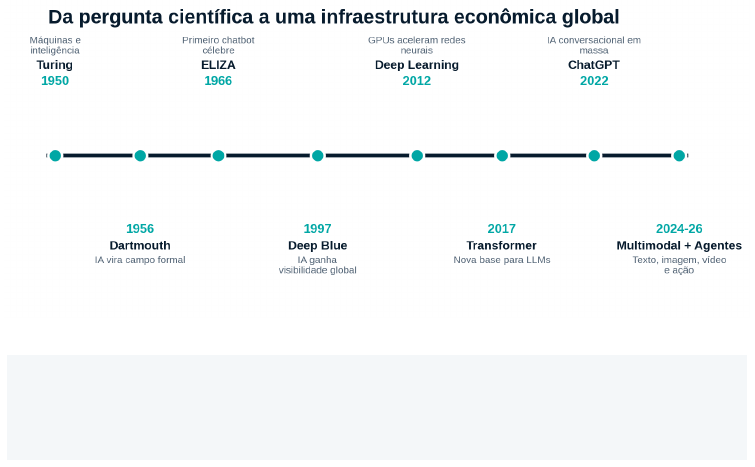
In 1950, Alan Turing helped turn the question "can machines think?" into a scientific problem. In 1956, the Dartmouth workshop consolidated the term Artificial Intelligence and organized a research field dedicated to language, reasoning, abstraction, and machine learning.
Why were there periods of frustration? Many ideas were good, but hardware, data, and computational cost were still insufficient. The so-called "AI winters" are a reminder that algorithmic innovation without infrastructure may not reach scale.
Rules and expert systems
The first major school of AI attempted to represent knowledge as explicit rules: if a condition occurs, then an action must be executed. It worked well in controlled domains, but the real world has too many exceptions, ambiguities, and combinations.
Machine Learning
With more data and processing capacity, systems began to learn patterns from examples. Instead of programming every rule, the developer defines data, objective, training method, and metrics.
Deep Learning + GPU
Deep neural networks expanded the capacity for image, voice, and language recognition. GPUs, initially popular in computer graphics, became essential because they execute a large volume of mathematical operations in parallel.
Chatbots, LLMs, and agents: from ELIZA to tool-using systems
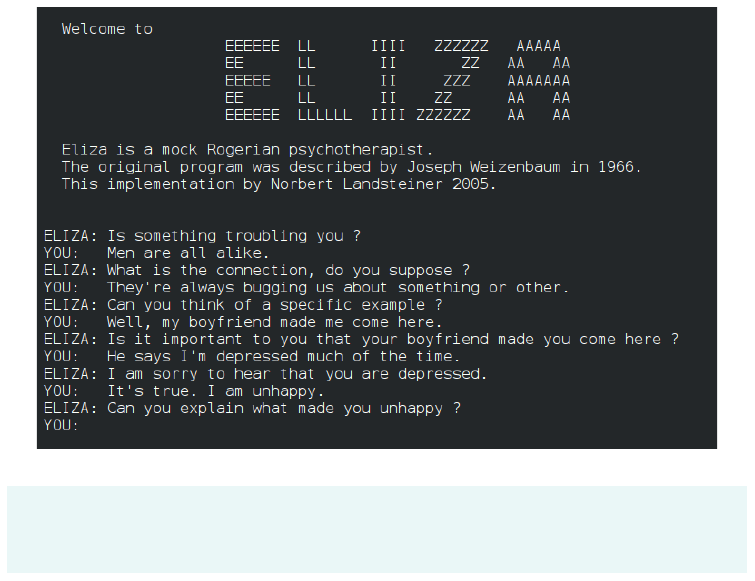
ELIZA, developed by Joseph Weizenbaum at MIT in the 1960s, is a landmark in the history of chatbots. Its DOCTOR script responded through patterns and text transformations. The system did not "understand" in the way a modern model does, but it demonstrated how much a text conversation can induce the perception of intelligence.
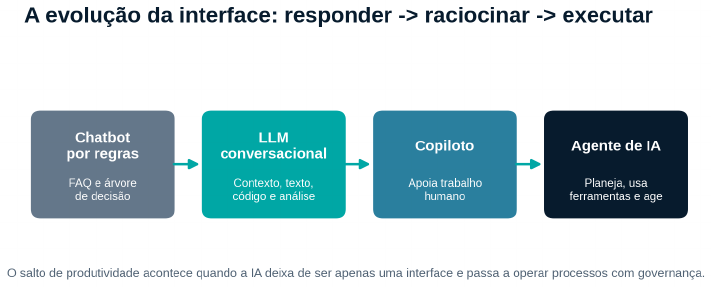
What has changed? Old bots followed flows. LLMs calculate probable continuations based on representations learned at large scale and can combine context, instructions, and external tools.
What characterizes an AI agent?
- Receives a goal and breaks the task down into steps.
- Consults systems, APIs, databases, or authorized RAG bases.
- Uses tools, executes actions, and logs results.
- Can work with other specialized agents.
- Requires identity, permissions, auditing, limits, and human approval when risk increases.
Governance point: the more autonomy, the greater the need for access control, traceability, risk assessment, and separation between recommendation and execution.
Image, video, and multimodality
In traditional computer vision, the question was: "what exists in this image?". With generative models, the question became: "what image or scene should be created from this description?". Diffusion models and multimodal architectures have reduced the distance between natural language and visual production.
| Modality | Before | Now |
|---|---|---|
| Text | Classification and search | Writing, synthesis, code, analysis, and dialogue |
| Image | Object recognition | Generation, editing, variations, and composition |
| Audio | Transcription and commands | Synthetic voice, authorized cloning, translation, and dialogue |
| Video | Frame analysis | Scene generation, editing, and preview |
| Multimodal | Separate pipelines | Text, image, audio, and video in the same context |
Creative impact: marketing, design, games, audiovisual, education, and e-commerce have started using natural language as a creation interface. The competitive edge shifts from "accessing the tool" to building better processes, data, identity, and curation.
Why does video cost more compute? Video adds a temporal dimension. The model needs to maintain coherence across frames, motion, camera, lighting, and visual identity. This increases memory, throughput, and inference time — and puts even more pressure on GPU infrastructure.
Companies and the economy: productivity, automation, and new business models
The real gain appears when model, data, and operations are integrated with governance.
| Area | AI applications | Expected value |
|---|---|---|
| Sales | Qualification, proposals, research, follow-up | More speed and coverage |
| Marketing | Content, segmentation, image, video, analysis | More experimentation and personalization |
| Customer service | Assistant, knowledge search, summarization | Lower response time |
| Technology | Code, testing, documentation, troubleshooting | Higher technical productivity |
| Operations | Forecasting, maintenance, computer vision | Fewer failures and better utilization |
| Finance | Reconciliation, documents, anomalies, forecast | More control and predictability |
| Management | Conversational BI, scenarios, executive copilots | More informed decisions |
The practical rule: start with the process, not the model. Define KPI, data, risk, integration, and owner. Then choose the technology.
Corporate AI tends to migrate from individual tools to an operational layer: copilots within existing systems, agents connected to CRM/ERP/ITSM, document automation, predictive analytics, and conversational interfaces over proprietary data.
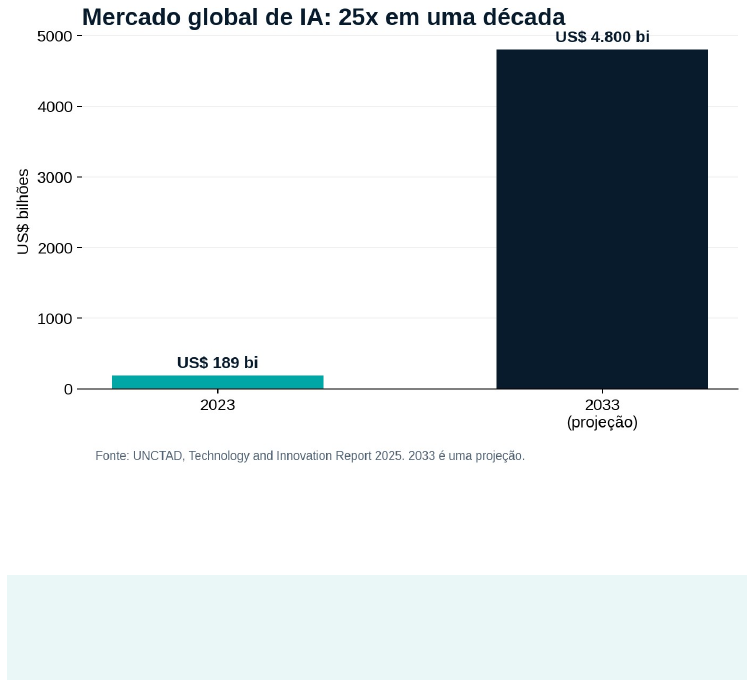
UNCTAD projects that the global AI market will grow from US$189 billion in 2023 to US$4.8 trillion in 2033. This is a projection, not a guarantee, but the order of magnitude shows why chips, data centers, energy, and fiber have started receiving extraordinary investment.
The chain of the new economy: semiconductors → GPU and HBM → servers → networking → storage → data center → energy → models → applications. Economic value is distributed across several layers, and the bottleneck can migrate from one to another.
AI infrastructure: GPU, memory, network, storage, and AI Factories

When a user generates a response, an image, or a video, the request travels through networks, enters a data center, consumes memory and accelerated compute, and returns through the connectivity infrastructure. At a scale of millions of users, small inefficiencies become large costs.
Engineering mindset: the server is just one component. For AI at scale, the entire data center participates in performance: power per rack, cooling, network topology, storage, fiber, automation, and 24x7 operations.
| Characteristic | CPU | GPU / accelerator |
|---|---|---|
| Purpose | Versatility and low latency per task | Massive parallelism |
| Cores | Few complex cores | Many parallel cores/units |
| Strength | General logic, systems, databases | Matrices, tensors, training, and inference |
| Memory | Conventional RAM | HBM and high bandwidth |
| AI scale | Coordinates and prepares workloads | Executes most of the neural compute |
Training adjusts a model's parameters using enormous volumes of data and can occupy thousands of accelerators for long periods. Inference is the use of an already trained model. In popular services, inference can become the largest aggregate consumption because it occurs continuously.
The invisible bottleneck: a fast GPU can sit idle waiting for data, another GPU, or storage. That's why low-latency networks and parallel storage are part of AI performance.
| Layer | Requirement | Why it matters |
|---|---|---|
| Compute | GPU, CPU, and accelerators | Execute training and inference |
| Memory | HBM + high-capacity RAM | Feed accelerators without delay |
| Fabric | InfiniBand or Ethernet HPC/RDMA | Communicate across thousands of accelerators |
| Storage | NVMe, parallel, high throughput | Datasets, checkpoints, and models |
| Energy | Substation, UPS, and dense distribution | Support high-power racks |
| Cooling | DLC/CDU/chillers/dry coolers | Remove heat efficiently |
| DCI | Fiber, DWDM, redundant routes | Connect regions and clusters |
| Software | Scheduler, drivers, observability | Use hardware efficiently |
AI Factory: the term describes infrastructure designed to transform energy and data into training and inference capacity at scale. Density per rack can be several times higher than in traditional corporate environments.
Liquid cooling: why high-density racks change thermal engineering
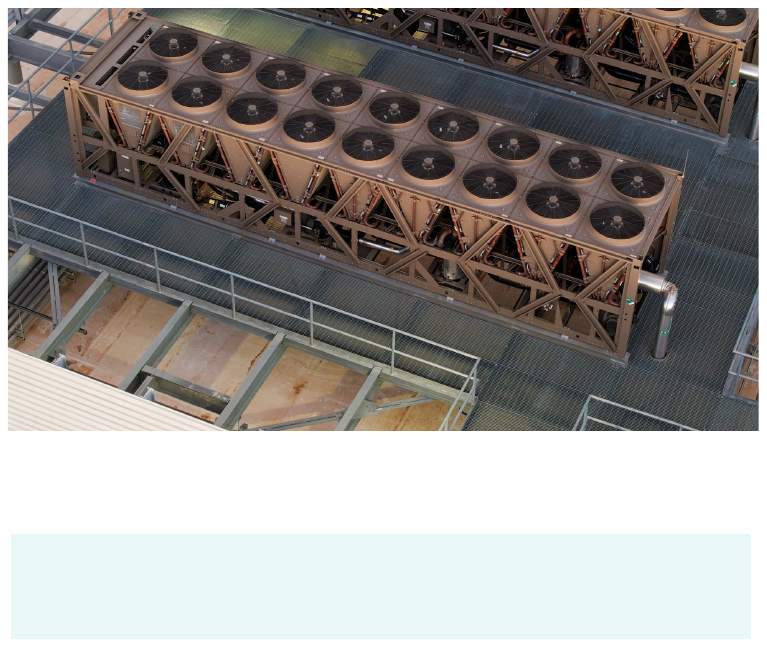
Almost all the electrical energy consumed by IT equipment ends up as heat. In high-density racks, moving that heat with air alone requires large volumes of airflow and ventilation. Liquid cooling brings a much more efficient thermal medium closer to the heat source.
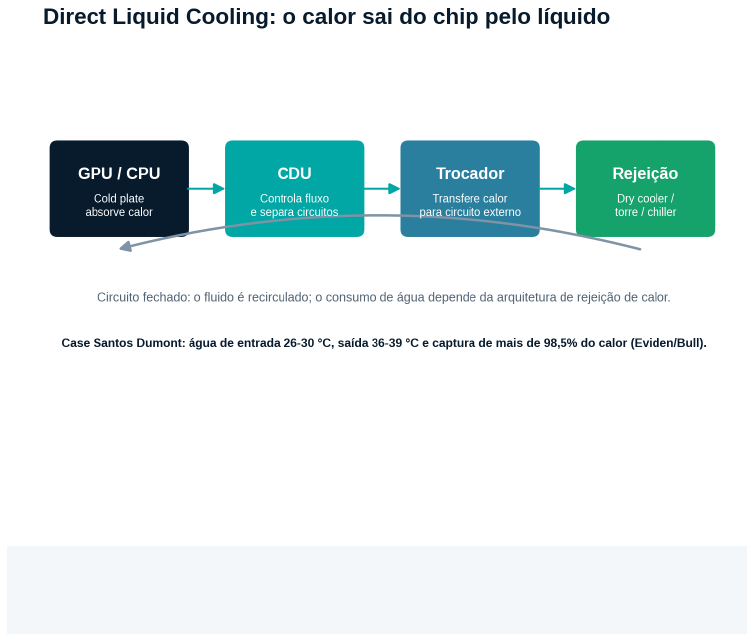
Don't confuse: liquid cooling doesn't necessarily mean continuous consumption of large volumes of water. The internal circuit can be closed. Water consumption depends on how heat is rejected externally — for example, through a dry cooler, chiller, or evaporative tower.
Why is liquid efficient?
Liquids carry far more heat per unit of volume than air. This reduces dependence on fans, increases density, and allows heat recovery at more useful temperatures. Engineering, however, becomes more sophisticated: fluid quality, pressure, flow rate, redundancy, leak detection, CDU, and maintenance all need to be part of the design.
The most important metric: don't evaluate cooling by PUE alone. For AI, also look at density per rack, water temperature, rejection capacity, redundancy, WUE where applicable, and electrical chain efficiency.
Santos Dumont case: H100, GH200, MI300A, InfiniBand, and DLC in Brazil

Located at LNCC, in Petrópolis-RJ, the system operates as SINAPAD's Tier-0 and has installed capacity on the order of 20 PFLOP/s. The current configuration combines the BullSequana X1000 and XH3000 platforms, with different generations of CPUs and accelerators.
The project is relevant because it shows how AI and supercomputing require integrated architecture: accelerators, InfiniBand fabric, parallel storage, and high-efficiency cooling.
| Component | Published configuration |
|---|---|
| BullSequana XH3420 | 60 CPU nodes, 2x AMD Genoa-X 9684X and 1.5 TB RAM per node |
| BullSequana XH3145-H | 62 nodes; 4x NVIDIA H100 SXM 80 GB per node |
| BullSequana XH3515-H | 36 nodes; 4x NVIDIA GH200 Grace Hopper per node |
| BullSequana G383-R80 | 18 nodes; 2x AMD Instinct MI300A per node |
| Interconnect | High-throughput, low-latency InfiniBand |
| Storage | Lustre + DDN Exascaler; on the order of 4 PB aggregated |
DLC in the case: Eviden/Bull states that the XH3000 expansion uses Direct Liquid Cooling with inlet water between 26°C and 30°C and return between 36°C and 39°C, capturing more than 98.5% of the heat from power supplies, processors, accelerators, network, disks, and memory.
Density: according to Eviden/Bull, the DLC system allows density up to 5x that of traditional air-cooled systems. The case materializes the central trend of AI data centers: more compute per square meter requires new thermal engineering.
Energy for AI: grid, PPAs, solar, wind, hydro, BESS, and resilience
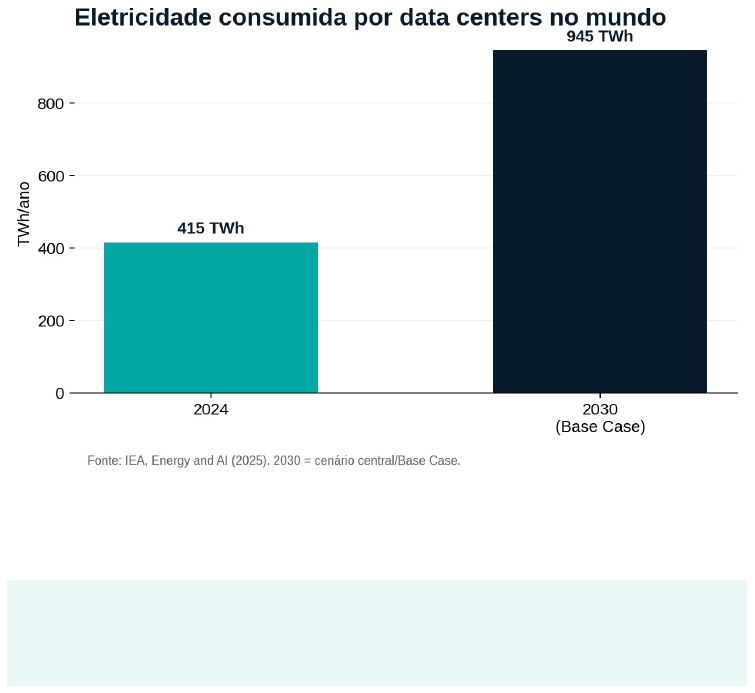
The IEA estimates around 415 TWh of electricity consumed by data centers in 2024, approximately 1.5% of global electricity consumption. In the central scenario, demand rises to around 945 TWh by 2030. AI is cited as the main incremental driver.
The bottleneck may be outside the data center: GPUs can be delivered in months; transmission lines, substations, and large-scale connections can take years. That's why power availability and energization timelines enter the feasibility study early.
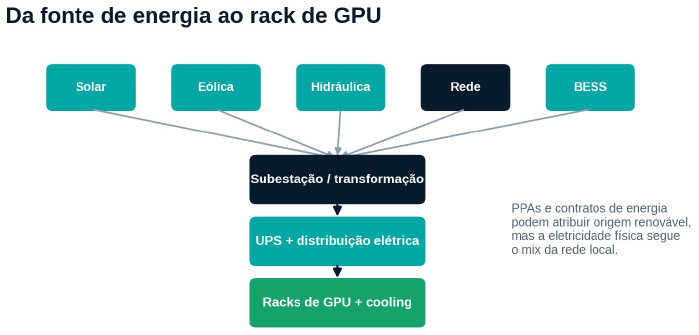
A data center normally receives electricity from a grid that combines several sources. A company may contract PPAs, certificates, or long-term contracts, but the physical electron that reaches the site follows the mix of the local electrical system. That's why "contractual origin" and "physical mix" are different concepts.
Sources and mechanisms appearing in new projects
- Solar and wind: relatively fast construction and competitive costs in many regions.
- Hydro: firm or flexible source depending on the system and hydrology.
- BESS: batteries help with flexibility, peaks, and renewable integration; they don't replace long-duration generation on their own.
- Gas, nuclear, and geothermal: dispatchable or firm sources relevant in certain markets.
- Grid + PPAs: the most common model combines a robust grid connection with energy contracts and local redundancy.
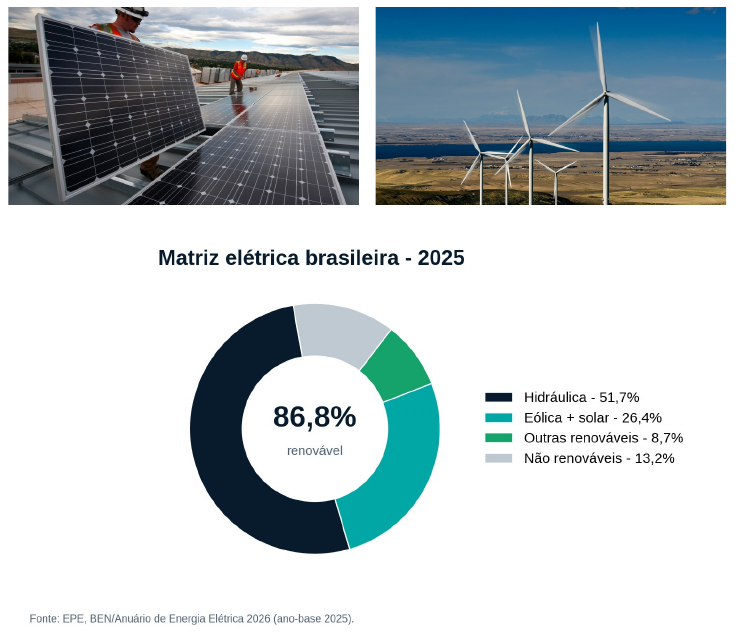
According to EPE, renewable sources accounted for 86.8% of domestic electricity supply in 2025. Hydro accounted for 51.7%; wind and solar combined for 26.4%. This characteristic can contribute to Brazil's attractiveness for energy-intensive digital infrastructure.
Global data center status: hyperscale, colocation, enterprise
According to Synergy Research Group, the number of large data centers operated by hyperscale companies reached 1,360 at the end of 2025. They accounted for 48% of global capacity. The company projects that this share will reach 67% by 2031, while total market capacity continues to grow.
| Model | Typical role | Trend with AI |
|---|---|---|
| Enterprise on-premise | Internal and legacy systems | May receive local GPUs, but loses aggregate share |
| Colocation | Professional shared infrastructure | Grows in MW and hosts private/hybrid environments |
| Hyperscale | Cloud and global platforms | Main driver of capacity expansion |
| Neocloud / GPU cloud | On-demand accelerated compute | Grows with training and inference workloads |
| Dedicated AI Factory | Massive, high-density clusters | Design driven by energy, fabric, and liquid cooling |
Global connectivity: DCI, DWDM, fiber, and submarine cables
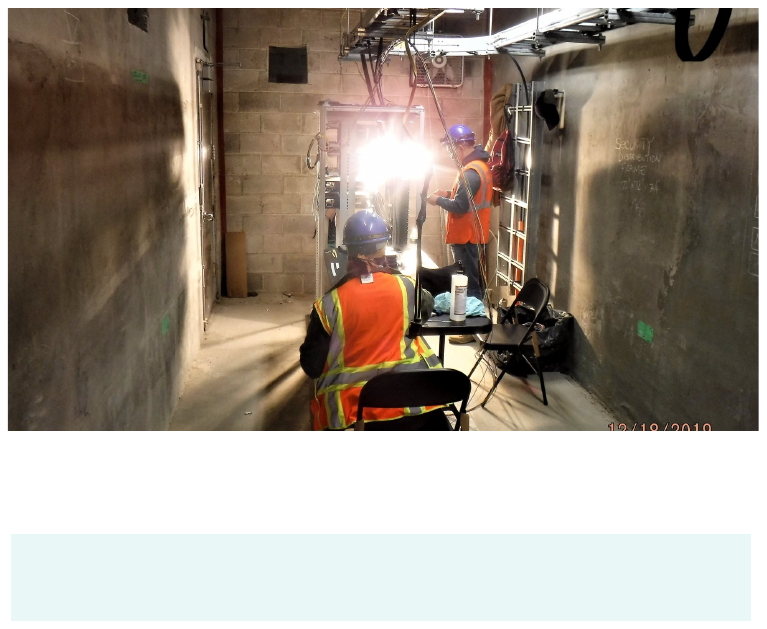
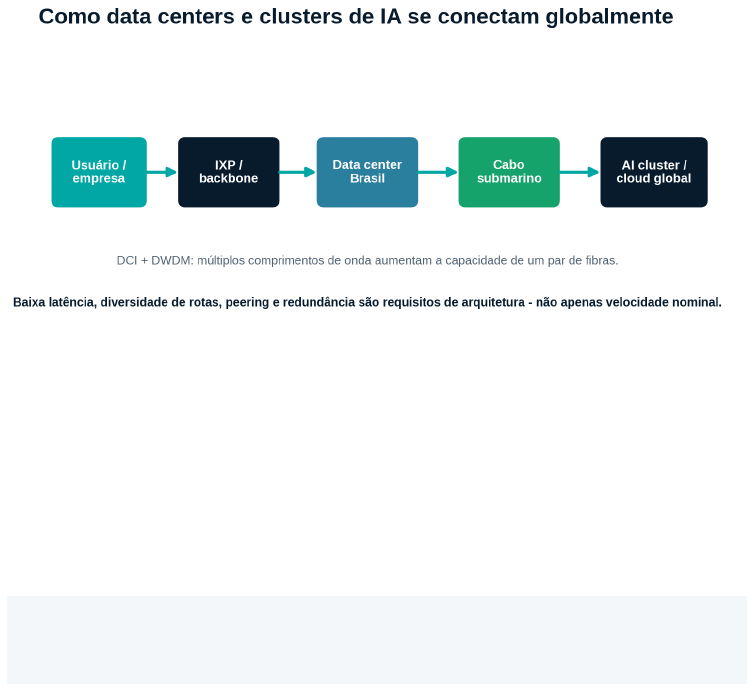
Distributed training exchanges large volumes of data between accelerators. Storage systems also need to feed GPUs continuously. Outside the cluster, DCI connects metropolitan and regional data centers, while long-haul networks and submarine cables connect continents.
Capacity isn't the only metric: for distributed AI, watch latency, jitter, loss, oversubscription, physical path, redundancy, MTU, RDMA, telemetry, and behavior during failures.
DCI — Data Center Interconnect
DCI connects different facilities with dedicated optical links or high-capacity services. In distributed architectures, two units can operate as parts of the same logical environment, respecting distance and latency limits.
DWDM — multiple "lanes" on the same fiber
Dense Wavelength Division Multiplexing carries multiple wavelengths on a single fiber pair. Each lambda can carry hundreds of gigabits per second, allowing capacity to scale without installing a new cable for each increase.
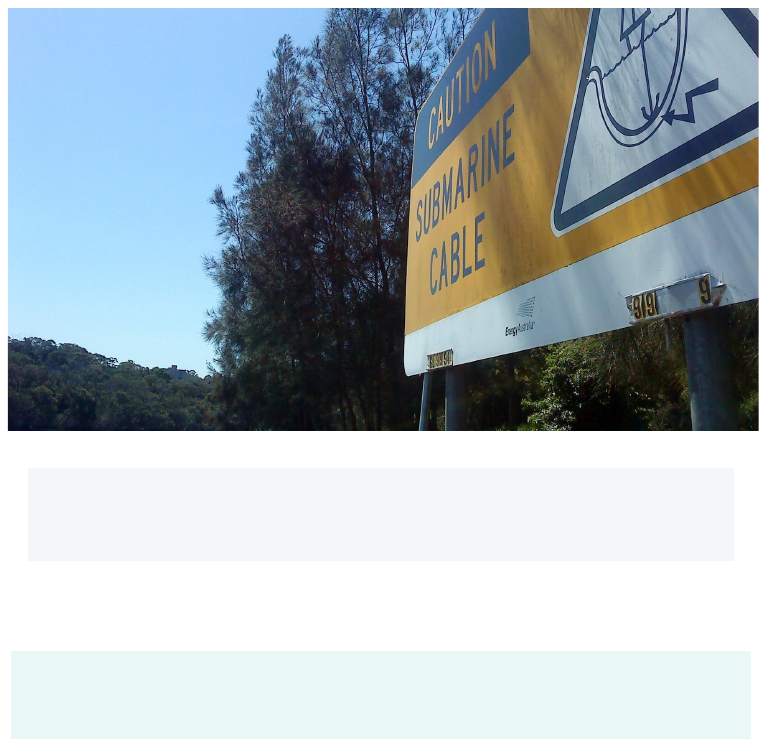
The ITU describes submarine cables as the hidden backbone of global connectivity. They carry cloud, financial transactions, content, and traffic between regions. Resilience depends on route diversity, landing stations, repair capacity, and planning against physical failures.
AI increases the importance of the network: models, datasets, and users are distributed. Computational capacity may be located in another country; without robust international connectivity, experience and resilience degrade.
Brazil in the new digital geography
Brazil combines a relevant consumer market, extensive telecommunications infrastructure, and an electricity matrix with a strong renewable component. São Paulo concentrates much of the demand and corporate interconnection; Fortaleza holds a strategic position on Atlantic submarine routes. The opportunity, however, requires projects with real electrical capacity, redundant connectivity, and predictable licensing.
Competitive advantage only exists when it's deliverable: having renewable resources in the country doesn't mean a specific plot of land has power available. The study must go down to substation level, connection queue, fiber route, and expansion capacity.
Compute capacity becomes an economic and strategic asset. Ports, energy, telecommunications, and logistics have always been decisive infrastructures for competitiveness. AI adds a new layer: accelerated computational capacity. A country or company that controls access to chips, energy, data, models, and connectivity has greater freedom to innovate and operate critical systems.
Five vectors of the new race
- Semiconductors: access to GPUs, HBM, advanced packaging, and manufacturing capacity.
- Energy: availability of megawatts, price, and connection timeline.
- Data centers: density, liquid cooling, security, and operations.
- Models and data: intellectual property, sovereignty, and governance.
- Networks: fiber, DCI, landing stations, IXPs, and diverse international routes.
Digital sovereignty in practice: it doesn't necessarily mean doing everything in-house. It means avoiding unmanaged dependencies, having architectural alternatives, and knowing where data, compute, keys, models, and routes are located.
What comes next: AI Factories, computational sovereignty, and autonomous agents
The roadmap brings together business, data, security, and infrastructure.
| Stage | Key question | Deliverable |
|---|---|---|
| 1. Use case | What problem and what KPI? | Business case and success criteria |
| 2. Data | Where is it, who can access it? | Data map and usage policy |
| 3. Model | Cloud, API, open model, or private? | AI architecture |
| 4. Integration | Which systems and tools? | APIs, RAG, agents, and workflow |
| 5. Risk | What can be automated? | Guardrails, approval, and auditing |
| 6. Infra | GPU, storage, network, energy, and cooling? | Sizing and technical design |
| 7. Operations | How to monitor cost, quality, and failures? | SLOs, FinOps, and AIOps |
Buy vs. build decision: most companies combine models via API/cloud with their own data and controls. Sensitive, predictable, or intensive workloads may justify private infrastructure, colocation, or dedicated GPU cloud. The answer depends on total cost, latency, sovereignty, and utilization.
In 1956, artificial intelligence was a scientific ambition. Today, it converses, creates, analyzes, and executes. The next leap doesn't depend only on better models: it depends on sufficient computational capacity to serve users and companies with cost, reliability, and sustainability.
That's why understanding AI requires looking beyond the algorithm. GPUs need memory. GPUs at scale need low-latency fabrics. Fabrics need storage. Everything needs energy. Energy becomes heat. Heat needs to be removed. And the result needs to travel across national and global networks.
The central thesis of this guide: artificial intelligence is becoming global economic infrastructure. Those who plan compute, energy, cooling, and connectivity as an integrated system will be better prepared for the next decade.
Sources
- Dartmouth AI, Artificial Intelligence — Our Story.
- Weizenbaum, J., ELIZA — A Computer Program for the Study of Natural Language Communication, Communications of the ACM, 1966.
- Vaswani et al., Attention Is All You Need, NeurIPS, 2017.
- UNCTAD, Technology and Innovation Report 2025: Inclusive AI for Development.
- IEA, Energy and AI (2025).
- EPE, Balanço Energético Nacional 2026 — base year 2025.
- LNCC, Santos Dumont Supercomputer Configuration.
- Eviden/Bull, Santos Dumont, LNCC supercomputer, receives fourfold upgrade.
- Synergy Research Group, Hyperscale Operators to Account for 67% of all Data Center Capacity by 2031.
- ITU, Global Connectivity Report 2025 and Submarine Cable Resilience.
Note on projections: future figures for market size, energy consumption, and capacity share are scenarios or projections from the indicated sources. They may change with efficiency, demand, regulation, supply chain, and energy availability.