
A Bare Metal server is a physical server dedicated entirely to a single customer or environment, with no mandatory hardware sharing with other tenants. CPU, memory, controllers, disks, and network interfaces remain under the exclusive domain of the contracting party — the operating system or hypervisor is installed directly on the equipment, preserving predictability, isolation, and configuration freedom.
About this material: content consolidated from technical references and EnQ Digital's project experience, with a cutoff date in 2026. Prices, specifications, and hardware availability should be confirmed before contracting.
What is Bare Metal
Bare Metal does not mean "without virtualization." It is the dedicated physical foundation on which VMs, containers, databases, or native applications can run. Its core characteristics include dedicated physical resources and consistent performance, full administrative access to the operating system or hypervisor, network topology, security, and storage defined according to the workload, and lifecycle, patching, backup, and monitoring governed by clear responsibilities.
When it makes sense
The decision should consider load profile, operational sovereignty, licensing, latency, and financial predictability. Priority use cases include transactional and analytical databases with intense I/O, ERP, CRM, billing, and critical 24x7 platforms, private virtualization and Kubernetes clusters, AI, GPU, rendering, HPC, and scientific processing, VDI, games, streaming, and jitter-sensitive applications, and regulated environments or those with strong isolation requirements.
Sustained CPU/RAM usage, the need for specific hardware, high per-core licensing costs, heavy traffic, dependence on low latency, or the need for deep control are all signals favorable to Bare Metal. Unpredictable, highly elastic loads, short-lived prototypes, or fully managed services tend to benefit more from public cloud or PaaS.
Physical architecture
The outcome depends on the whole set: server, rack, power, cooling, network, security, and operation.
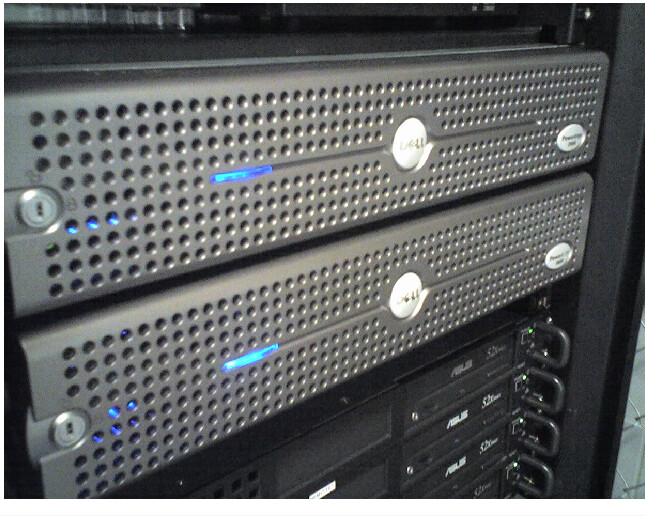
A typical solution is organized into layers: compute (1U/2U servers, CPU, RAM, GPU) to run workloads; storage (NVMe/SAS/SATA, SAN/NAS/object) for persistence and performance; network (ToR switches, routers, links) for redundant connectivity; security (HA firewalls, WAF, IDS/IPS) for segmentation and protection; and facility (rack, A/B power, cooling) for physical availability.
Design principles include eliminating single points of failure when RTO requires it, separating management, production, storage, backup, and cluster networks, documenting ports, VLANs, IPs, dependencies, and flow matrix, and reserving electrical, thermal, and physical capacity for growth.
Server hardware in depth
The corporate server is an integrated system: chassis, motherboard, processors, memory, buses, controllers, disks, network, power supplies, cooling, and out-of-band management.
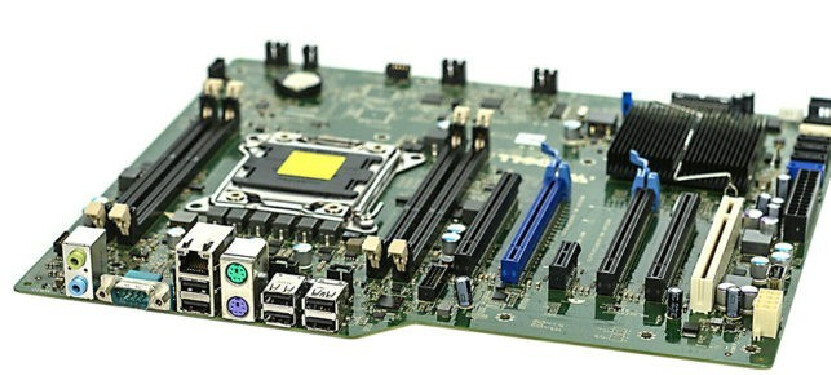
Among the components and criteria to evaluate are the 1U/2U/4U chassis (bays, airflow, GPU and expansion — impacts density and cooling), the CPU (sockets, cores, clock, cache, TDP, PCIe — impacts performance and licensing), ECC RAM (capacity, channels, DIMMs, frequency — impacts reliability and NUMA), PCIe (generation, lanes, and physical slots — impacts NIC, HBA, NVMe, and GPU), the BMC (remote access, console, virtual media — out-of-band operation), and power supplies/fans (redundancy, power, and hot-swap — continuity and maintenance).
1U servers maximize density but have less room for disks, cards, and airflow. 2U models offer better expansion and can accommodate more GPUs or NVMe units — the choice must respect weight, rack depth, power per outlet, and thermal dissipation. The processor generation determines supported memory, channels, capacity, PCIe, and security features: it is necessary to check lane distribution between sockets, PCIe bifurcation, the electrical width of slots, and contention among NICs, HBAs, NVMe, and accelerators.
Processing, memory, and NUMA
The choice of CPU and RAM should follow the actual application behavior, not just nominal count. Cores favor parallelism; frequency and IPC favor latency-sensitive threads. NUMA, cache, vector instructions, and cryptographic acceleration can significantly change the outcome. For memory, it is necessary to size capacity, occupied channels, frequency, ECC, and growth margin — in-memory databases and virtualization require special attention to NUMA and host reservation.
In platform decisions: a single socket can reduce licensing costs, while two expand cores, RAM, and PCIe; DIMMs should be distributed symmetrically across channels and sockets; vCPU, memory, and device should stay close together on NUMA when possible; TDP should be validated against cooling, power, and sustained frequency; and BIOS, BMC, NIC, HBA, and controller should be certified together as a single firmware set.
As good practices: prefer benchmarks that represent the workload, control overcommit and affinity when predictability is critical, monitor CPU ready, steal, page faults, swapping, and memory bandwidth, and validate BIOS, firmware, and operating system compatibility.
Subsystems, expansion, and accelerators
Final performance is limited by the most restrictive link among CPU, RAM, PCIe, storage, and network. Never size a server based on CPU alone: confirm the complete data path, from disk or network all the way to memory and the processor/accelerator.
For internal storage, consider the RAID controller (hardware or software, depending on the system), the SAS/SATA/NVMe backplane compatible with the quantity and speed of the drives, protected cache with a write-back policy consistent with the risk, and hot-swap features, indicators, spares, and telemetry for safe maintenance.
For network and I/O, evaluate 10/25/40/100/200 GbE NICs according to traffic and protocol, offloads, RSS, RDMA/RoCE, and SR-IOV when the workload requires it, Fibre Channel or SAS HBAs with certified drivers and firmware, and transceivers, DAC/AOC, fiber, and switches compatible end to end. For GPU and accelerators — AI, rendering, and HPC — it is necessary to evaluate the quantity and type of GPU, HBM/VRAM memory, interconnect between accelerators, PCIe lanes, power, air or liquid cooling, and software stack compatibility.
Hardware lifecycle
Reliability depends on standardization, compatibility, parts, and firmware discipline. Governance includes defining a certified baseline of BIOS, BMC, NIC, HBA, RAID, and drives, updating in waves with testing, windows, backup, and rollback, monitoring predictive alerts, SSD wear, ECC, temperature, and power supplies, maintaining critical parts and manufacturer support with defined replacement procedures, and recording serial number, warranty, configuration, and history in the CMDB.
For platform security, enable Secure Boot, TPM, strong BMC passwords, an isolated management network, certificates, logs, and firmware updates — disable legacy protocols and unused ports. For end of life, plan renewal before support ends: migration, cryptographic or physical media sanitization, certified disposal, and inventory updates should all be part of the project.
Automation with Ansible
Ansible standardizes configuration, reduces manual tasks, and creates a repeatable trail for the Bare Metal operational cycle. It applies to post-installation provisioning, hardening, users, packages, agents, services, network configuration, backup, observability, patching, compliance, and evidence collection — vendor collections can also automate BMC, BIOS, RAID, and firmware, depending on available support.
The recommended structure includes dynamic inventory by environment, role, location, and criticality; reusable roles with variables protected by a vault/secrets manager; idempotent playbooks that can be run again without producing unwanted changes; check mode, lint, tests, and approval before production; serialization and failure limits to preserve quorum and availability; and execution logs integrated into the pipeline and change management.
A typical flow goes through discovery (validate BMC, interfaces, disks, and version), bootstrap (create secure access and repositories), baseline (hardening, NTP, DNS, certificates, and syslog), agents (monitoring, backup, EDR, and inventory), patch (canary → batch → validation → next batch), and evidence (change and compliance report). For clusters, use batch execution and health checks: remove a node, update, validate, reintegrate, and only then move on.
Terraform and OpenTofu
Terraform and OpenTofu describe infrastructure as code; Ansible complements this by configuring the system and applications. When the provider, manufacturer, or platform exposes an API/provider, IaC can request servers, VLANs, addresses, rules, DNS, IPAM, volumes, credentials, and integrations. In environments without a provider, modules can orchestrate APIs, pipelines, or provisioning platforms.
Terraform is a HashiCorp product in the HCL language; OpenTofu is an open source project under the Linux Foundation, compatible with HCL/the ecosystem — the choice between the two involves policy, support, and providers on one side, and open governance and compatibility on the other.
As good practices: keep the remote state encrypted, with locking, versioning, and minimal access; separate states by environment and failure domain; pin provider versions and review the lock file; require plan in pull requests, with apply under approval and a service identity; never place secrets in code, open variables, or outputs; and maintain drift detection, controlled importing, and policy as code. The typical integrated pipeline follows: commit → validation/lint → terraform/tofu plan → approval → apply → dynamic inventory → Ansible → tests → CMDB/monitoring. The state represents resources; it does not replace documentation, backup, or corporate inventory.
Storage and I/O
Capacity in TB is only part of the equation: IOPS, latency, throughput, durability, and recovery define the real experience. Among storage profiles are local NVMe (strong in latency and IOPS, used in databases, cache, and analytics), local SAS/SATA (cost/capacity, used for files and local backup), SAN/iSCSI/FC (sharing and HA, used in clusters and virtualization), NFS (simplicity and sharing, used for content and repositories), and S3/object (scale and API, used for backup, data lake, and media).
RAID reduces the impact of disk failure but does not replace backup — it is necessary to consider the controller, protected cache, hot spare, rebuild, and the risk of correlated failure. The practical rule is 3-2-1: at least 3 copies of the data, on 2 distinct media or domains, with 1 copy outside the primary environment. For ransomware protection, add immutability and real restoration tests.
Network and connectivity
The network must deliver bandwidth, latency, redundancy, and security compatible with the application.
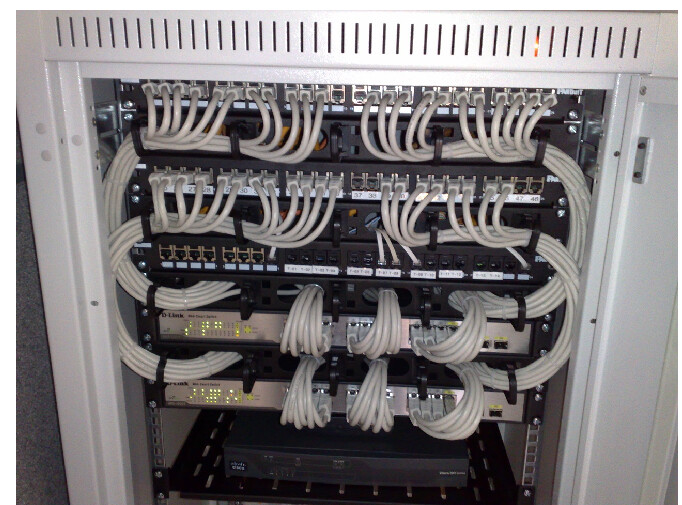
The recommended design includes two interfaces per critical plane, distributed across distinct switches; bonding/LACP when supported, with redundant routes and gateways; VLANs/VRFs to separate management, production, storage, backup, and replication; dedicated connectivity, Internet, IP transit, peering, or cross-connect as needed; and consistent QoS and MTU end to end, especially for storage.
Capacity should be sized according to peak demand, replication, backup, and growth, measuring useful throughput, packets per second, latency, jitter, loss, and uplink occupancy. DDoS protection should combine upstream capacity, detection, mitigation, and an activation runbook — a local firewall alone cannot absorb volumetric attacks.
3-layer network topology
The classic model separates the functions of Core, Distribution, and Access, facilitating growth, policies, and failure isolation.
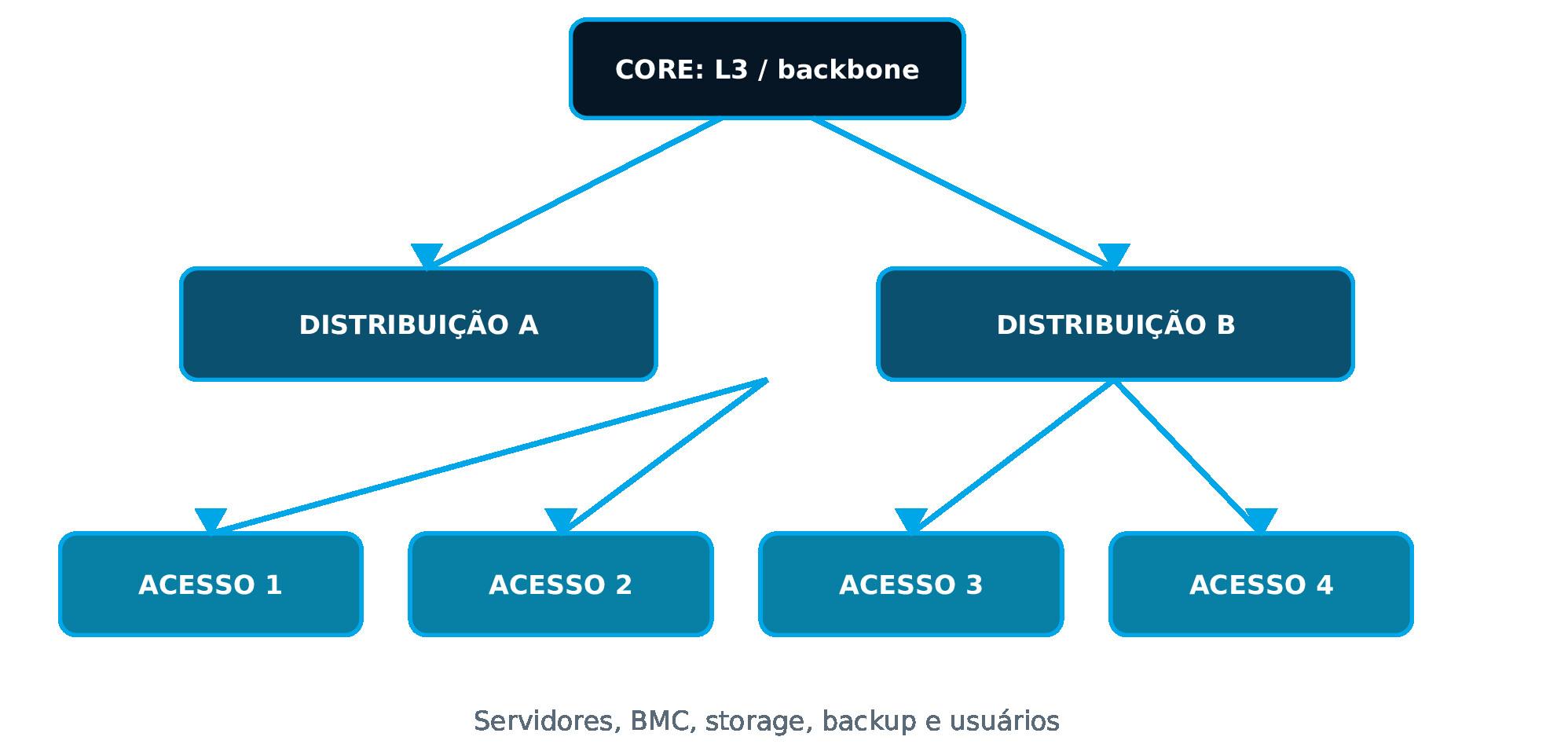
Each layer has a clear responsibility: the Core is the high-speed, low-latency backbone (L3 routing, ECMP, connection between blocks); Distribution handles policy, aggregation, and failure boundary (VRF, ACL, gateways, summarization); and Access provides the direct connection of the equipment (hosts, BMC, storage, backup).
A basic redundant design provides for a pair of devices in Core and Distribution when the SLA requires it, dual-homed access for critical servers with distinct NICs and paths, separate VLANs or VRFs for production, management, storage, backup, and cluster, LACP/MLAG or L3 routing depending on support, scale, and operation, and Spanning Tree only with controlled roots and domains, avoiding large L2 domains. In larger-scale data centers, leaf-spine topology frequently replaces the classic hierarchical model; for small and medium environments, Core and Distribution can be collapsed into a single pair of switches while maintaining logical separation.
3-layer application
The Web–Application–Data architecture separates exposure, business logic, and persistence, allowing specific controls and scalability for each layer.
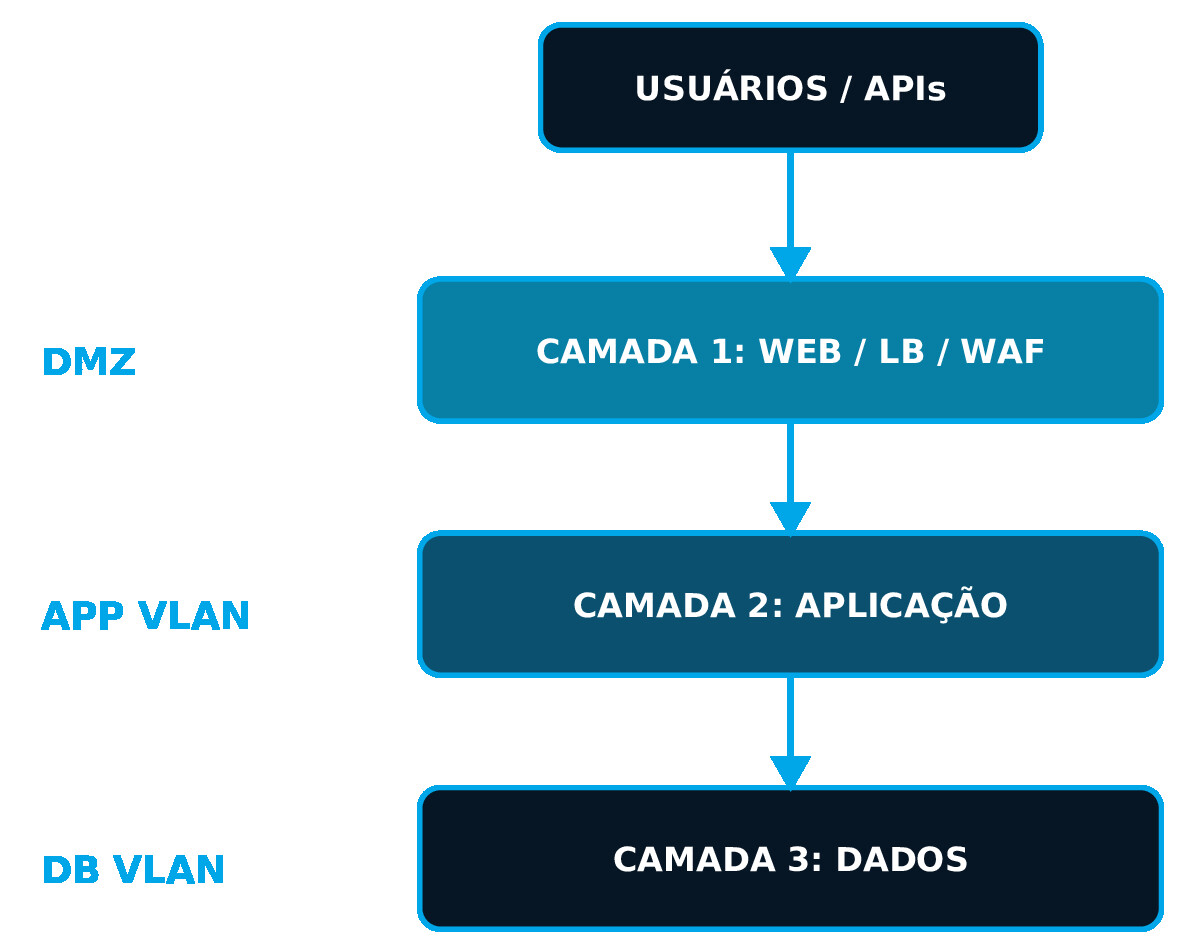
Layer 1 (Web) gathers WAF, load balancer, proxy, and front-end, and receives external traffic without direct access to the database. Layer 2 (Application) gathers APIs, services, queues, and workers, executing business logic and accessing only specific data ports. Layer 3 (Data) gathers database, cache, storage, and backup, with restricted network and segregated administration.
An EnQ Bare Metal reference example combines two firewalls in a cluster at the edge, two load balancers or a redundant virtual service at the Web layer, two or more application servers (allowing per-node maintenance), a database cluster or replica with protected storage and backup, and an out-of-band management network with cross-cutting observability. The central security principle: the Internet never directly accesses the application or the database — each layer allows only the explicitly necessary flows.
Security and clustered firewall
Defense in depth combines physical, network, identity, host, application, and data controls. An active-passive or active-active firewall pair reduces downtime from failure and maintenance — the design should include session/state synchronization, a dedicated heartbeat, redundant WAN/LAN links, and controlled failover tests.
Essential controls include least privilege, MFA, and segregated administrative accounts; a bastion host or VPN for management, never exposing administrative interfaces directly; microsegmentation, deny-by-default, and periodic rule review; EDR, hardening, vulnerability management, and patches; encryption in transit and, depending on risk, also at rest; and centralized logs in a SIEM, with retention and audit trail. High availability without testing is just a hypothesis — it is necessary to exercise failover, restoration, and incident response on a defined schedule.
High availability and continuity
Availability comes from design and operation, not from a single robust piece of equipment. Five concepts organize the conversation: SLA (what availability does the service assume?), RTO (how long can it be unavailable?), RPO (how much data can be lost?), HA (how to maintain service in the face of local failures?), and DR (how to recover in another domain/location?).
Failure domains to consider include A/B power supplies and PDUs, redundant switches and firewalls, a host cluster when the application is not natively distributed, replication and backup in a separate domain, and a secondary site when the impact justifies the investment.
Attention: HA does not replace DR; replication does not replace backup; and the infrastructure SLA does not automatically equal the application SLA.
Operation and observability
The dedicated server needs industrial routine: inventory, monitoring, change, incident, capacity, and security.
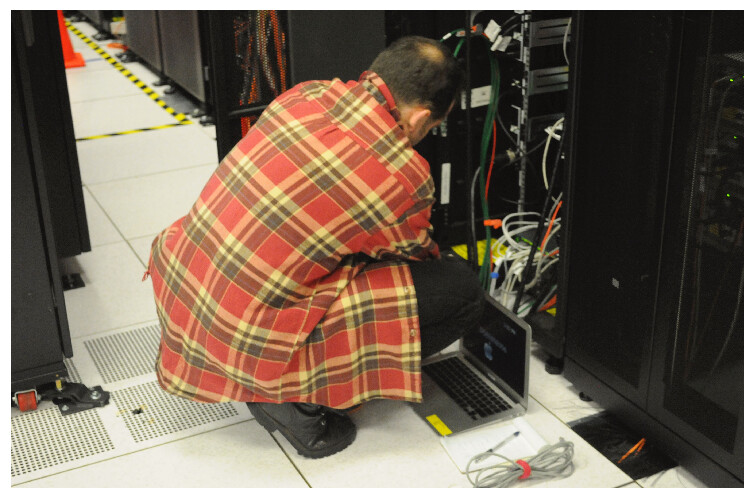
Minimum telemetry covers hardware health via BMC/IPMI/iLO/iDRAC; CPU, RAM, filesystem, disks, RAID, and temperature; interfaces, errors, drops, latency, and network utilization; services, transactions, queues, database, and user experience; and security events, authentication, and administrative changes. In management, it is necessary to define owners for hardware, operating system, middleware, application, backup, firewall, and connectivity, maintaining a CMDB, runbooks, change windows, and escalation. Monitoring resources is not enough: infrastructure must be correlated with service and business indicators.
Virtualization, containers, and Kubernetes
Bare Metal is a flexible platform for consolidation or direct execution. In the direct-on-operating-system execution model, the gain is lower overhead and more control, at the cost of less consolidation flexibility. With a hypervisor, isolation, HA, and snapshots are gained, but licensing and cluster operation must be considered. Containers bring portability and density, requiring attention to persistence and security. Kubernetes brings orchestration and scale, at the cost of greater operational complexity.
Hypervisors such as VMware, Hyper-V, Proxmox VE, KVM, and others can be installed according to compatibility, licensing, and support model. Running Kubernetes on Bare Metal avoids an additional virtualization layer, but requires its own design for load balancer, CNI, CSI, ingress, observability, upgrades, and control plane recovery.
Performance and sizing
Reliable sizing starts with real metrics and includes margin, peaks, failures, and growth. The recommended process is to collect percentiles for CPU, RAM, IOPS, latency, throughput, and network; classify peaks, seasonality, and backup windows; model growth over 12 to 36 months; apply an operational margin and an N+1 scenario; and run a proof of concept with a representative dataset and concurrency.
An illustrative example: a measured demand of 24 cores at 70% at peak suggests an initial design of 32 to 48 physical cores; 220 GB of RAM at peak suggests 384 GB ECC; 8 TB usable with 120 thousand IOPS suggests NVMe with protection and headroom; and 3.5 Gb/s peak suggests 2×10/25 GbE. The values are illustrative — compression, RAID, hyperthreading, NUMA, replication, and protocol all influence the final performance.
Bare Metal vs. cloud vs. colocation
There is no universal winner; there is a best fit for the workload and operating model. In hardware, managed Bare Metal is dedicated, public cloud is shared/dedicated, and colocation uses the customer's own hardware. In elasticity, public cloud leads (high), followed by Bare Metal (medium) and colocation (low/medium). In control, colocation offers the most, Bare Metal is high, and cloud is variable. In initial investment, Bare Metal and cloud tend to be low/medium and low respectively, while colocation requires high investment. Physical operation stays with the provider in Bare Metal and cloud, and with the customer (via contract) in colocation. In predictability, Bare Metal and colocation tend to be high, while cloud is variable.
A common hybrid strategy keeps stable data and workloads on Bare Metal, using the cloud for managed services, burst, global distribution, or disaster recovery.
Costs and TCO
Total cost comparison should use a common horizon, with transparent assumptions. TCO components include monthly fee or amortization of server, rack, and facility; licenses per core, socket, host, VM, or capacity; links, IPs, cross-connects, and data transfer; backup, security, monitoring, and support; team, on-call, change, migration, and decommissioning; and the cost of unavailability and risk.
A simple model: TCO = infrastructure + software + connectivity + operation + migration + residual risk. Compare horizons of 24, 36, and 60 months, and perform sensitivity analysis for growth and exchange rates. A lower unit price can result in a higher TCO if the design increases licensing, downtime, or operational effort.
Migration and deployment
A safe transition reduces risk through discovery, pilot, waves, and rollback. The typical steps are: inventory of applications, dependencies, data, licenses, and requirements; HLD/LLD design, addressing, rules, and responsibilities; provisioning, hardening, monitoring, and backup; functional, load, failover, restoration, and security testing; pilot migration and migration in waves of criticality; cutover with go/no-go criteria and a rollback plan; and hypercare, acceptance, documentation, and optimization.
Possible methods include rehost, rebuild, continuous replication, backup/restore, and VM migration — the choice depends on tolerable downtime, compatibility, and data volume. Before the cutover, validate synchronization, capacity, DNS, certificates, firewall, backup, observability, communication, and rollback authority.
Bare Metal EnQ Digital
EnQ Digital structures tailor-made Bare Metal environments, combining dedicated servers, connectivity, security, storage, and deployment and operation services — the final scope is defined according to criticality, location, capacity, and desired responsibility.
Possible solutions include dedicated servers for applications, databases, virtualization, containers, and AI; segmented networks, dedicated connectivity, and Internet; clustered firewalls and access policies according to the project; local or shared storage, backup, and replication; automation with Ansible and infrastructure as code with Terraform/OpenTofu, according to scope and available APIs; monitoring, support, and management according to the contracted SLA; and single-site, N+1, cluster, or alternate-site recovery architectures. The consultative differentiator: the project is born from the workload — capacity, RTO/RPO, security, licensing, and growth are translated into a coherent technical and commercial architecture.
Reference architectures
Three conceptual patterns should be adjusted to the risk and the actual application. The "essential dedicated" pattern combines 1 server, external backup, and a firewall — suited for non-critical workloads or those with HA already resolved at the application level. The "local cluster" pattern combines 2 to 3 hosts, storage/replication, and a firewall in HA — suited for virtualization and critical services. The "two sites" pattern combines clusters, replication, and immutable backup — suited when RTO/RPO are demanding and continuity is a priority.
The typical logical flow follows: users/Internet → DDoS protection → redundant routers → clustered firewalls → redundant switches → servers/cluster → storage and backup, with management using a segregated plane and secure access. The architecture must be born from failure impact — duplicating everything without mapping dependencies can leave invisible single points and raise costs without delivering the expected SLA.
Procurement checklist
Use these questions to compare proposals at the same level of rigor. On the technical side: what CPU, RAM, disks, RAID, NICs, and expansion capability? Are there redundant power supplies, PDUs, switches, links, and firewalls? What bandwidth, allowance, DDoS protection, IPs, and expected latency? How are backup, retention, immutability, and restoration handled? Which firmware, OS, and hypervisor versions are supported?
On the operational and commercial side: what SLA, 24x7 coverage, response times, and escalation? What is the customer's responsibility versus the provider's? Is there inventory, monitoring, reporting, and change management? What are the costs of installation, licensing, traffic, expansion, and exit? How does secure data return or destruction occur? Attach the architecture, the responsibility matrix, the SLAs, and the acceptance criteria to the contract.
Conclusion
Bare Metal delivers isolation, control, and predictable performance. The value appears when hardware, network, security, data, continuity, and operation are treated as a single system — not as isolated components chosen and operated separately.
The natural next step is to map workload, criticality, growth, and operational responsibility to design the Bare Metal environment suited to each operation.
Photo credits: rack servers — Dsv, public domain; server motherboard — Marcin Wieclaw, CC BY-SA 4.0; switches and patch panels in a 19-inch rack — Dsimic, CC BY-SA 4.0; technician at a rack at NERSC — Derrick Coetzee, CC0 1.0. Sources: Wikimedia Commons. Images cropped/resized only for layout purposes.